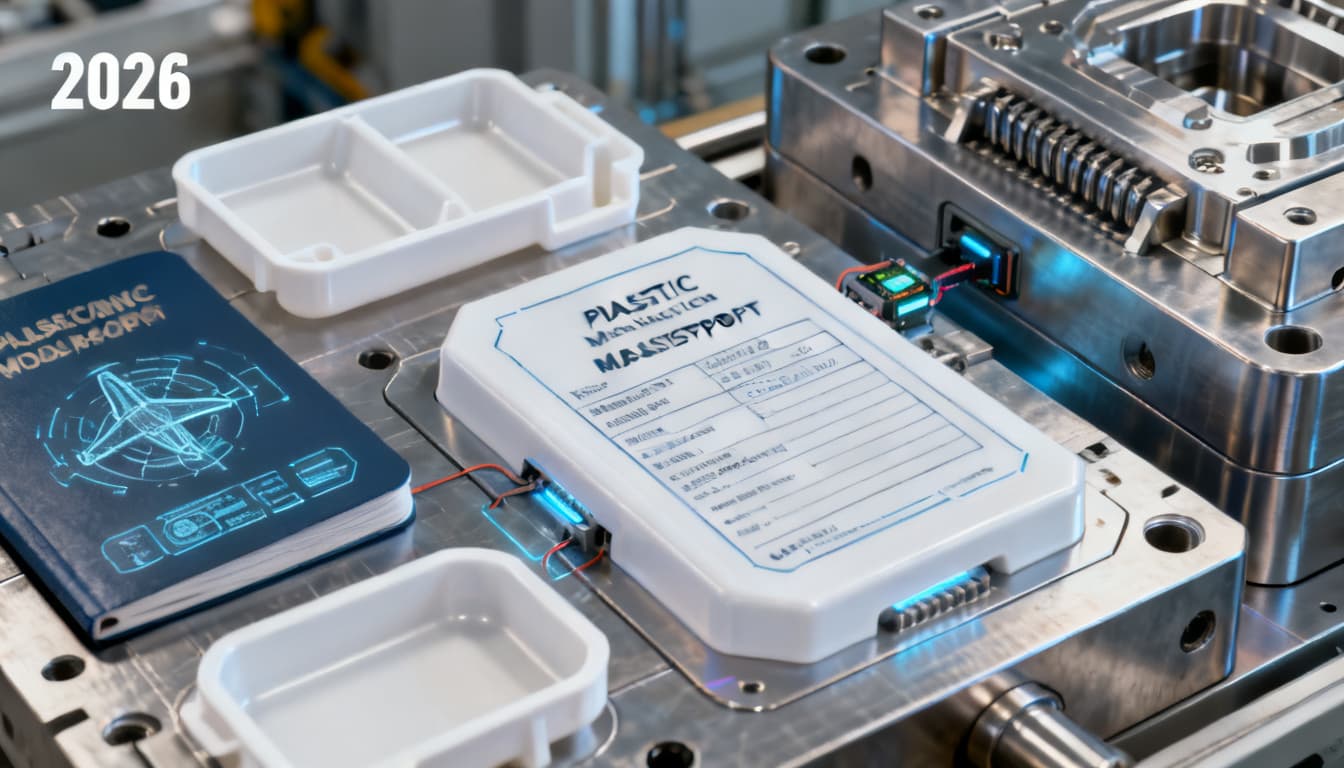
2026 Best Practices for Aerospace Plastic Injection Molding Products: Digital Material Passports and In-Mold Sensor Integration
The aerospace supply chain is accelerating its shift from metal to high‑performance thermoplastics — not just for secondary brackets and clips, but for structural components that carry flight loads. Injection molding now delivers complex geometries in PEEK, PEI, and carbon‑filled PPS that rival alum
2026 Best Practices for Aerospace Plastic Injection Molding: Digital Material Passports and In-Mold Sensor Integration
Why 2026 Will Separate Aerospace Molders With Digital Traceability From Those Without
The aerospace supply chain is accelerating its shift from metal to high‑performance thermoplastics — not just for secondary brackets and clips, but for structural components that carry flight loads. Injection molding now delivers complex geometries in PEEK, PEI, and carbon‑filled PPS that rival aluminum in strength‑to‑weight ratio while cutting part count and assembly time. First Mold’s overview of aerospace injection molding highlights how the process is ideal for producing large quantities of intricately designed, lightweight parts that once required expensive machining or casting. Yet the real inflection point in 2026 isn’t material performance — it’s traceability.
Programs like the F‑15 radar sensing device covers that Midwest Mold supported demonstrate that tooling and production expertise are table stakes. What separates the next generation of aerospace molders is the ability to deliver a complete digital thread: every pellet of resin, every cavity pressure curve, every second of hold time, linked to a part serial number and stored in a tamper‑evident record. This is the domain of digital material passports and in‑mold sensor integration.
Paper‑based material certifications and handwritten process logs are no longer defensible. When a single out‑of‑spec lot can ground a fleet, OEMs and Tier‑1 integrators are demanding that molders provide real‑time process data tied to material genealogy. A molder that cannot produce a digital passport — aggregating resin lot numbers, drying parameters, cavity pressure traces, and post‑molding dimensional scans — will find itself locked out of new programs. The push for digital traceability is also fueled by the rise of on‑demand, low‑volume production. RapidDirect’s model shows that even small‑batch aerospace orders can be manufactured with digital technology at the center, compressing lead times and enabling rapid design iterations without sacrificing documentation rigor.
In 2025, several aerospace suppliers encountered audit failures when paper material certs couldn’t be reconciled with actual production lots. Those incidents — while not publicly detailed — have rippled through procurement departments, making digital material passports a contractual requirement in new RFQs. Molders who adopt in‑mold sensors and blockchain‑ready passport platforms now are building the competitive moat that will define the 2026 landscape.
How In-Mold Sensor Integration and Digital Material Passports Function in Aerospace-Grade Molding
In‑mold sensors transform the injection mold from a passive cavity into an intelligent data generator. Piezoelectric pressure sensors, thermocouples, and, increasingly, fiber‑optic strain gauges are embedded directly into the mold steel — typically behind ejector pins, in the gate area, or at the end of fill. During each cycle they capture cavity pressure, melt temperature, and viscosity in real time. This data is streamed to a process monitoring system that compares every shot against a golden reference profile. If the cavity pressure curve deviates beyond a predefined envelope — say, a 5% drop in peak pressure indicating a short shot or material degradation — the system can automatically quarantine the part before it ever reaches assembly.
A digital material passport aggregates these process fingerprints with the material’s full genealogy. When the resin arrives at the molder’s facility, its certificate of analysis, lot number, and even transport temperature logs are ingested into a secure database. As the material is dried and fed into the press, the passport records drying time and dew point. During molding, the in‑mold sensor data for each part is appended, along with any post‑mold dimensional inspection results. The final passport becomes a single, cryptographically signed file — often structured as an IPC‑1782‑compliant XML record — that can be shared with the OEM or regulatory body without exposing proprietary process settings.
The Machinery Network’s technical guide underscores that aerospace‑grade molding demands conformance to standards like FAR 25.853 and MIL‑STD‑810. A digital passport makes proving that conformance instantaneous: the auditor can verify that every part in a lot was molded within the validated process window, using material from an approved source, without sifting through binders of paper.
To understand the operational leap, compare the traditional paper‑based approach with a fully digital material passport system.
| Comparison Metric | Traditional Paper Traceability | Digital Material Passport | Selection Criteria & Failure Boundary |
|---|---|---|---|
| Data capture method | Handwritten log sheets; manual entry of resin lot numbers | Automated sensor streaming + barcode/RFID material scan | Manual systems fail when operators skip entries; digital capture is continuous and tamper‑evident |
| Process‑to‑part linkage | Timestamped batch records; no per‑part process data | Every part serial number linked to its cavity pressure curve and melt temperature trace | Without per‑part linkage, a single bad shot can contaminate an entire lot during recall |
| Audit response time | Days to weeks; requires physical document retrieval | Minutes; auditor queries database by part serial or date range | Delays in audit response can stall aircraft delivery; digital systems enable same‑day closure |
| Material genealogy depth | One level back (resin supplier CofA) | Multi‑tier: resin batch, compounder lot, drying parameters, transport conditions | When a raw material alert is issued, digital passports pinpoint affected parts in hours, not weeks |
| Risk of counterfeit material | High; paper certs can be duplicated or misattributed | Low; blockchain‑anchored hashes and digital signatures prevent forgery | Counterfeit PEEK or PEI can cause in‑flight failures; digital provenance is a safety imperative |
| Integration with OEM PLM/ERP | Manual re‑keying; high error rate | API‑driven data exchange using XML/JSON schemas | Lack of integration creates data silos; digital passports feed directly into digital twin models |
Tip: When evaluating a digital passport platform, ask whether it supports the IPC‑1782 standard for traceability data exchange. This ensures the passport can be ingested by major aerospace OEMs’ quality systems without custom translation.
Sensor placement itself demands careful mold design. Upmold’s injection mold specifications detail the structural considerations for incorporating sensor ports without creating stress risers. Protolabs’ DFM guidelines reinforce that wall thickness and rib design must accommodate sensor bosses, especially near the gate where pressure gradients are steepest. The sensor must sit flush with the cavity surface to avoid part marking, yet be accessible for replacement without disassembling the entire mold base.
Meeting AS9100, ITAR, and FAR 25.853 With Automated Digital Records
Aerospace injection molders operate under a web of regulations that demand rigorous documentation. AS9100 requires that organizations maintain records of conformity for all products, including evidence that processes were carried out under controlled conditions. ITAR (International Traffic in Arms Regulations) mandates strict access controls on technical data related to defense articles. FAR 25.853 sets flammability, smoke, and toxicity requirements for materials used in aircraft interiors. Digital material passports and in‑mold sensor data address all three simultaneously — and with far less human error than manual systems.
Protolabs’ certifications include AS9100 and ITAR registration, demonstrating that a digital‑first approach to manufacturing documentation is not only feasible but expected by aerospace customers. The Machinery Network’s compliance overview notes that materials must conform to FAR 25.853, and that proving conformance requires traceable test reports. A digital passport can embed the actual flame test data for the resin lot, cross‑referenced to the molded part, so that an FAA inspector can verify compliance without pulling physical samples.
| Standard / Regulation | Core Documentation Requirement | How Digital Passports + In‑Mold Sensors Help |
|---|---|---|
| AS9100 (Clause 8.5.1) | Controlled conditions for production, including documented process parameters and material traceability | In‑mold sensors record actual process parameters per cycle; digital passport links material lots to each part, satisfying traceability requirements automatically |
| ITAR (22 CFR §120–130) | Access control on technical data; need‑to‑know basis for foreign nationals | Digital passports can be encrypted and access‑partitioned so that only U.S. persons see controlled process data, while still providing material provenance to authorized parties |
| FAR 25.853 (a) | Flammability test reports for each material/part combination | Passport embeds the resin supplier’s test report and links it to the molded part; any process deviation that could affect flammability (e.g., excessive residence time) triggers an alert |
| MIL‑STD‑810 (environmental) | Evidence that parts withstand operational shock, vibration, temperature | Sensor data during molding can be correlated with later mechanical test results, creating a closed‑loop validation record that proves process consistency |
| IPC‑1782 (traceability standard) | Standardized data exchange format for material and process traceability | Digital passports built on IPC‑1782 ensure interoperability with OEM quality systems, reducing integration cost |
The real power of automated digital records is in audit efficiency. Instead of a quality engineer spending three days pulling paper travelers for a lot of 500 parts, they run a query: “Show all cavity pressure traces for serial numbers 1001–1500, molded on April 12, 2026, using resin lot XJ‑8872.” The system returns a PDF report with cryptographic proof that the data hasn’t been altered. For ITAR‑controlled projects, the same system can redact sensitive process parameters while still proving material authenticity — a capability that manual logs simply cannot offer.
Specifying and Sourcing Aerospace Injection Molding With Embedded Sensor Integration
Writing an RFQ for a sensor‑integrated aerospace mold requires more than adding a line item for “in‑mold sensors.” You need to define the data deliverables, the sensor types and locations, and the format of the digital passport. Here’s how to structure your sourcing process to avoid costly rework and ensure the molder can actually deliver on the promise of digital traceability.
Start with the part design. Protolabs’ DFM toolkit provides guidelines on wall thickness, rib geometry, and boss design that are essential when you plan to embed sensors. A pressure sensor near the gate requires a flat, untextured surface on the cavity wall; if your part has a Class‑A surface in that area, you’ll need to negotiate an acceptable witness mark or move the sensor to an ejector pin bore. Upmold’s mold design specifications detail how to reinforce the mold base around sensor ports to prevent cracking under clamp force. Include a note in your RFQ that the molder must perform FEA on the mold structure with sensor cutouts and share the results.
Next, specify the digital passport content. At a minimum, require:
- Resin supplier, grade, lot number, and certificate of analysis
- Drying parameters (temperature, dew point, duration)
- Molding machine ID and mold ID
- For each part: timestamp, cavity pressure peak, fill time, melt temperature at injection, hold pressure profile
- Post‑molding dimensional inspection results (key characteristics only)
- Cryptographic hash of the complete record
Ask the molder which traceability standard they follow — IPC‑1782 is the most widely recognized in aerospace — and whether their system offers an API for direct integration with your PLM or ERP. If you’re prototyping a new bracket or housing, consider using an on‑demand low‑volume service like RapidDirect that can implement digital passports without the upfront investment of a full production tool. This lets you validate the sensor layout and data pipeline before committing to a multi‑cavity production mold.
| RFQ Section | Key Specification | Why It Matters |
|---|---|---|
| Sensor types & locations | Piezoelectric pressure sensor at gate and end‑of‑fill; thermocouple in cavity wall; optional fiber‑optic strain gauge for thin‑wall sections | Ensures complete process fingerprint; avoids blind spots that could hide short shots or material variation |
| Data acquisition | Sampling rate ≥ 500 Hz per channel; data stored in time‑series database with export to CSV/JSON | High‑resolution data allows detection of transient defects like hesitation marks or jetting |
| Digital passport format | IPC‑1782 XML schema; SHA‑256 hash for integrity; optional blockchain anchoring | Guarantees interoperability and tamper evidence; blockchain anchoring provides independent verification |
| Mold design validation | FEA report showing stress distribution with sensor ports; mold flow simulation with sensor locations | Prevents mold failure and ensures sensor data correlates with actual flow behavior |
| Qualification run | 30‑shot capability study with all sensors active; CpK ≥ 1.33 for critical process parameters | Proves the sensor system can distinguish between normal variation and out‑of‑control conditions |
| Data access & security | Role‑based access; ITAR‑compliant data partitioning; API documentation | Protects sensitive process IP while enabling OEM oversight |
Note: Do not treat sensors as an afterthought. Retrofitting a production mold with sensor ports is possible — typically via wire EDM or gun drilling — but it requires careful FEA to avoid compromising the mold’s fatigue life. For new tools, design the sensor pockets into the mold from day one; the incremental cost is modest compared to the risk of a qualification failure.
What Senior Engineers and Procurement Leads Ask About Digital Passports and In-Mold Sensors
Q: How much do in-mold sensors add to the cost of an aerospace injection mold?
Typically 10–20% of the total tooling cost, depending on the number of sensors and the complexity of the wiring channels. However, the reduction in scrap — especially with expensive resins like PEEK — and the faster qualification (often shaving weeks off the PPAP process) usually deliver ROI within the first production run. When you factor in the avoided cost of a recall due to undocumented process drift, the business case becomes overwhelming.
Q: Can digital material passports integrate with our existing ERP and PLM systems?
Yes, most modern passport platforms offer REST APIs that can push traceability data directly into systems like SAP, Oracle, or Teamcenter. Ensure the molder uses a standard like IPC‑1782 or a compatible XML schema for traceability data exchange. This avoids proprietary formats that lock you into a single supplier. During the RFQ stage, request a sample JSON payload and test it against your PLM’s import utility.
Q: What sensor types survive high-temperature aerospace polymers like PEEK or PEI?
Piezoelectric pressure sensors with ceramic-coated diaphragms (e.g., Kistler Type 6182C) are the workhorses for melt temperatures up to 450°C. Sheathed thermocouples with Inconel housings handle the thermal cycling without drift. For EMI‑sensitive applications — such as parts near avionics — fiber‑optic sensors are emerging because they are immune to electromagnetic interference and can be embedded in thin‑wall sections without affecting the part’s dielectric properties.
Q: Is it possible to retrofit in-mold sensors into existing production tools?
Yes, via secondary machining for sensor ports, but it requires careful FEA to avoid compromising mold strength. Ejector pin bores are the most common retrofit locations because they already penetrate the cavity and can be sleeved to accept a miniature pressure sensor. However, retrofitting often costs 30–50% of a new mold’s sensor integration cost, and you may still lack the optimal gate‑proximal measurement. For critical aerospace parts, it’s usually more cost‑effective to design new tools with sensor integration from the start.
Q: How do digital material passports help with ITAR and export-controlled projects?
They provide encrypted, access‑controlled records that can be partitioned so only authorized U.S. persons see controlled process data, while still proving material provenance without revealing sensitive details. For example, the passport can show that a part was molded from a specific lot of ITAR‑controlled resin without exposing the resin’s formulation or the mold’s gate geometry. Role‑based access ensures that a foreign OEM receiving the part sees only the data necessary for installation and maintenance.
Q: What’s the minimum production volume to justify digital passport implementation?
Even low‑volume aerospace programs (50–500 parts) benefit when part criticality is high. On‑demand molding services like RapidDirect can implement digital passports without large upfront investment, using cloud‑based data collection and standardized sensor kits. The threshold isn’t volume — it’s risk. If a part’s failure could cause a system‑level hazard, the cost of a digital passport is negligible compared to the liability of an undocumented process.
As the aerospace industry moves toward full digital twins of every airframe, the injection molder’s ability to deliver a verified digital thread will become as important as the part itself. The molders who embrace in‑mold sensors and digital material passports today are building the infrastructure that will carry them through the next decade of programs. For a quote on your next aerospace project with integrated digital material passports, contact PandaMolding.
References & Further Reading
- Injection Molding in Aerospace: Key Components, Design Considerations, Materials, and Future Trends – First Mold
- Plastic Injection Molding Trends in Aerospace and Defense – Midwest Mold
- Plastic Injection Molding for Aerospace Components: Technical Guide – Machinery Network
- Low-Volume Plastic Injection Molding for Small Batch Production – RapidDirect
- Injection Mold Specifications & Plastic Mold Design Guideline – Upmold
- Plastic Injection Molding Design Guidelines – Protolabs
- DFM Guidelines for Injection Molding – Protolabs
- Protolabs Certifications: AS9100, ITAR