2026 Best Practices for Safe Injection Molding: Machine Guarding, Material Handling, and Operator Training Updates
Walk through any injection molding facility in early 2026 and you will see two things: machines running faster than their nameplate ratings, and operators who have been cross-trained across three more cells than they were two years ago. Supply chain volatility has compressed lead times. Reshoring in
Why 2026 Demands a Sharper Focus on Injection Molding Safety
Walk through any injection molding facility in early 2026 and you will see two things: machines running faster than their nameplate ratings, and operators who have been cross-trained across three more cells than they were two years ago. Supply chain volatility has compressed lead times. Reshoring initiatives have pushed older presses back into service. And the labor market—still tight for experienced setup technicians—means temporary operators are cycling through production floors at rates that make consistent safety training difficult.
None of this is theoretical. Recent incident reviews and structured risk assessments using frameworks like the ACE Mold risk assessment template reveal a stubborn pattern: guarding gaps and material-handling shortcuts remain the top root causes of preventable injuries in injection molding. The template's emphasis on identifying risks that lead to mold defects, material inconsistencies, and process disruptions applies equally to safety—because a process disruption that sends a clamp closed on an operator's hand is the ultimate quality failure.
Key Takeaway: Updated safety practices in 2026 are not a compliance checkbox. They are a competitive necessity. A single recordable injury can trigger an OSHA inspection, halt production for days, and erode the trust of the OEM customers who audit your facility. The plants that get this right treat machine guarding, material handling protocols, and operator training as a single integrated system—not three separate initiatives managed by different departments.
The good news is that the standards, tools, and training resources available today are more practical than ever. The challenge is that few shops have systematically updated their approach to match the realities of higher-throughput, mixed-experience production environments. This article walks through exactly what needs to change—and how to implement those changes without disrupting production.
Machine Guarding Anatomy: Fixed Barriers, Interlocks, and the Operator Gate
A safe injection molding cell relies on a layered defense. No single guard or interlock is sufficient on its own. Understanding how these layers work together—and where they typically fail—is the foundation of any credible safety program.
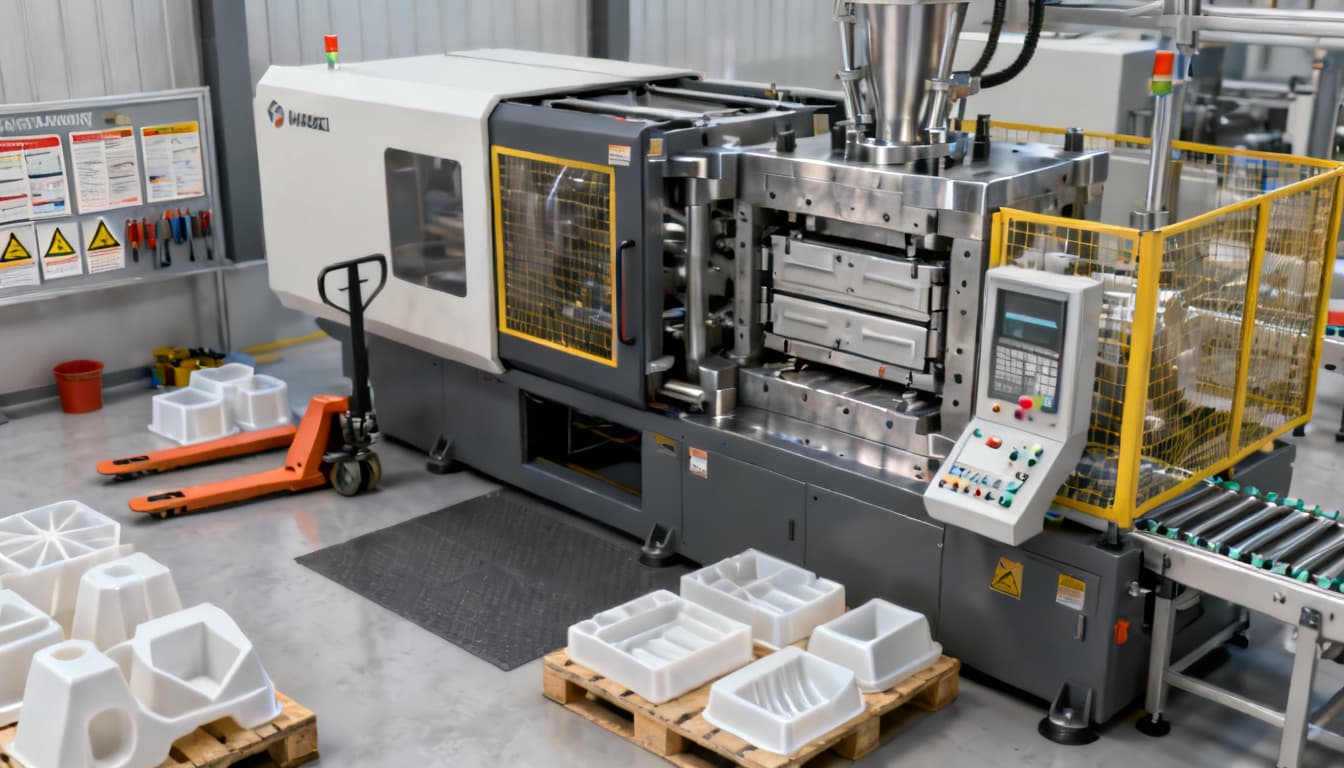
The OSHA eTool for horizontal injection molding machines identifies the operator gate as the primary movable guard. Its job is straightforward: block access to the clamping mechanism, ejector system, and mold cavity while the machine is in normal production. The eTool is explicit on one point that many shops overlook—you do not start a machine or leave it operating unless this guard is in place. On some machine designs, this guard is fixed and requires a tool to remove it, which is the safer configuration.
Behind the operator gate sits the interlock system. ANSI/PLASTICS B151.1-2017—the American National Standard governing safety requirements for horizontal and vertical clamp injection molding machines—specifies performance requirements for three interlock types: mechanical, electrical, and hydraulic. Each serves a distinct function, and each has failure modes that risk assessments must account for.
The mechanical interlock physically blocks mold closure when the gate opens. The electrical interlock cuts power to the clamp circuit. The hydraulic interlock blocks fluid flow to the clamp cylinder. In a properly designed system, all three work in parallel so that no single component failure can defeat the safety function. This is what ANSI B151.1 calls "control reliability," and it is the standard against which any retrofit—including light curtains—must be measured.
The table below summarizes the guarding and interlock types that every injection molding cell should include, along with the applicable standards and key performance requirements.
| Guard / Interlock Type | Function in the Safety System | Applicable Standard | Key Performance Requirement |
|---|---|---|---|
| Fixed Barrier Guard | Prevents access to clamp, ejector, and rear mold areas during all operating modes | ANSI B151.1, OSHA 1910.212 | Requires tool for removal; must withstand impact without deformation |
| Operator Gate (Movable Guard) | Primary movable barrier; blocks operator access to mold cavity during production | ANSI B151.1 §5.2, OSHA eTool | Must be interlocked; opening must stop mold closure within safe distance |
| Mechanical Interlock | Physically prevents mold closure when gate is open via blocking bar or latch | ANSI B151.1 §5.3 | Must withstand full clamp force without yielding; independent of control system |
| Electrical Interlock (Limit Switch) | Cuts power to clamp motor or solenoid when gate opens | ANSI B151.1, NFPA 79 | Dual-channel with cross-monitoring; single fault must not defeat safety function |
| Hydraulic Interlock (Blocking Valve) | Blocks hydraulic flow to clamp cylinder when gate is open | ANSI B151.1 §5.4 | Fail-safe design; loss of hydraulic pressure must default to blocked/closed state |
| Light Curtain (Retrofit Option) | Non-contact detection of operator presence in the mold area | ANSI B151.1, IEC 61496-1/-2 | Must meet stopping time and safety distance calculations; requires control-reliable circuit |
| Fixed Guard Interlock (Side/Rear) | Monitors fixed side and rear guards; shuts down machine if removed during operation | ANSI B151.1, OSHA 1910.212(a)(3)(ii) | Must be non-bypassable during normal production; keyed interlock preferred |
What the table cannot capture is how these systems interact in practice. A common failure mode occurs when a mechanical interlock is properly installed but the electrical interlock has been jumpered to speed up mold changes. The operator sees the physical guard in place and assumes the system is safe. It is not. This is why RJG's safety standards guidance emphasizes that guarding and barriers must be verified as a complete system—not as individual components checked off a list.
Tip: During your next mold change, have a technician open the operator gate while the machine is in semi-automatic mode and verify that the clamp does not move. If it does—or if the machine does not alarm—you have an interlock problem that needs immediate attention.
Template-Based Risk Assessments vs. Real-Time SPC: Which Catches More Safety Gaps?
Engineers and safety managers face a genuine strategic choice: invest in periodic, structured risk assessments using templates like the ACE Mold framework, or deploy continuous statistical process control (SPC) systems that monitor process variations in real time, as advocated by EAS change systems. The answer is not one or the other—but understanding what each approach catches and what it misses is essential for allocating limited safety resources.
Template-based assessments excel at finding structural problems: a missing side guard, an interlock that was never wired correctly, a material handling workflow that forces operators to reach across the mold area. The ACE Mold template, with its structured review of mold defects, material inconsistencies, and process disruptions, provides a framework that forces cross-functional teams to look at the entire cell—not just the machine. These assessments happen periodically, which means they can incorporate lessons learned from near-misses and incidents across the industry.
Real-time SPC takes a different approach. By continuously monitoring process parameters—injection pressure, clamp force, cycle time, temperature profiles—SPC systems detect deviations that may signal a developing hazard. A gradual increase in clamp force variability, for example, could indicate a hydraulic interlock that is beginning to stick. An operator might not notice it for weeks. SPC catches it within cycles.
The comparison below breaks down the key differences.
| Comparison Metric | Template-Based Risk Assessment (ACE Mold Framework) | Real-Time SPC Monitoring (EAS Change Systems Approach) | Selection Criteria & Failure Boundary |
|---|---|---|---|
| Detection Speed | Periodic—weeks or months between reviews; captures accumulated changes | Continuous—within cycles; detects deviations as they emerge | SPC wins for fast-developing hazards; templates catch slow, structural drift |
| Scope of Coverage | Broad: guarding, material handling, PPE, procedures, training records | Focused: process parameters, cycle consistency, machine performance trends | Templates cover human and procedural factors SPC cannot see; SPC covers machine behavior templates may miss between reviews |
| Human Factors Assessment | Strong—observes operator behavior, reach zones, fatigue patterns | Weak—cannot directly observe whether an operator is bypassing a guard | If your injury history involves operator error, templates are non-negotiable |
| Implementation Cost | Low to moderate—primarily labor hours for assessment team | Moderate to high—requires sensors, data infrastructure, and SPC software | Smaller shops may start with templates; high-volume cells justify SPC investment |
| Regulatory Acceptance | Well-established; OSHA inspectors recognize documented periodic assessments | Growing acceptance; demonstrates proactive monitoring but does not replace required periodic reviews | Both strengthen your position during an inspection; templates provide the documentation baseline |
The most effective safety programs in 2026 use both approaches in tandem. A quarterly template-based assessment identifies guarding gaps and procedural weaknesses. Real-time SPC monitors the process between assessments, flagging anomalies that warrant an immediate targeted review. The failure boundary is clear: relying exclusively on either approach leaves blind spots that a serious incident will eventually exploit.
EAS change systems makes a compelling case that quality control systems—including SPC, regular testing, and inspection protocols—catch defects early and identify process variations before they become safety issues. But no SPC system can tell you that a temporary operator was never shown how to verify the operator gate interlock. That requires a human-led assessment, documented and reviewed.
Material Handling and Operator Training: Updating Protocols for 2026's Smarter Shop Floors
Material handling injuries in injection molding fall into predictable categories: burns from hot runners or nozzle tips, cuts from purged plastic or trim tools, crush injuries from manual mold handling, and repetitive strain from awkward material loading positions. The PPE recommendations have not changed dramatically in recent years—but how shops integrate PPE into daily routines and verify compliance has evolved significantly.
Slideproducts' injection molding safety guide provides a practical PPE hierarchy that every shop floor supervisor should know. Heatproof, puncture-resistant gloves made from leather or Kevlar defend against cuts, burns, and abrasions during material handling and purging operations. Impact-resistant, anti-fog safety glasses with a snug fit keep debris and molten plastic splash out of the eyes. Hearing protection—earplugs or earmuffs—addresses the high decibel levels common during injection molding cycles, particularly on hydraulic machines with older pump designs.
What Slideproducts emphasizes—and what many shops overlook—is fit and compatibility. Gloves that are too loose create snag hazards around rotating feed screws. Safety glasses that fog up get removed, defeating their purpose. Hearing protection that interferes with communication leads to operators removing earmuffs to hear shift-change instructions. The PPE must work with the machine guarding, not against it.
Housekeeping is equally critical. Prototool's workshop safety rules stress two points that should be posted at every injection molding workstation: ensure there is no oil or water around the equipment to guarantee safe movement, and report any abnormalities—oil leaks, damaged wires, unusual noises—to the team leader or technician immediately. These are not suggestions. An oil leak near the clamp area creates a slip hazard directly in the operator's reach zone. A damaged wire on an interlock circuit can defeat the entire safety system without any visible indication.
The table below summarizes the updated PPE and training protocols that forward-looking shops are implementing in 2026.
| Protocol Element | 2024 Baseline | 2026 Update | Implementation Notes |
|---|---|---|---|
| Hand Protection | General-purpose work gloves | Kevlar or leather heatproof, puncture-resistant gloves rated for 300°F+ contact | Replace quarterly or after any visible heat damage; keep spares at each cell |
| Eye Protection | Standard safety glasses | Anti-fog, impact-resistant glasses with side shields; snug fit verified per operator | Conduct fit check during onboarding; fogged glasses = removed glasses |
| Hearing Protection | Disposable earplugs available | NRR 25+ earmuffs or custom-molded plugs; communication-compatible models for team leads | Post decibel readings at each machine; hydraulic presses often exceed 85 dBA |
| Housekeeping Audit | End-of-shift cleanup | Continuous visual checks; oil leaks, water puddles, and damaged wires reported immediately per Prototool protocol | Laminated checklist at each workstation; team lead verifies at shift start |
| Operator Training (Permanent Staff) | Annual classroom session | Quarterly hands-on walkthrough of operator gate, E-stops, and interlock verification on each assigned machine | Use OSHA's eTool safety tour as pre-refresher orientation |
| Operator Training (Temporary/Seasonal) | Brief supervisor walkthrough | Structured 30-minute orientation: eTool safety tour + machine-specific gate/E-stop demo + laminated emergency checklist | Document completion; temporary operators must demonstrate interlock check before independent operation |
| Nozzle/Mold Maintenance Safety | Verbal warning about hot surfaces | Written procedure requiring heat-resistant gauntlets, face shield during nozzle removal, and verification of barrel depressurization | Prototool guidance: take protective measures to prevent burns from hot materials or gas splashes during nozzle work |
Training temporary operators without slowing production is one of the hardest challenges in injection molding. The OSHA eTool safety tour—an interactive, browser-based walkthrough of horizontal injection molding machine hazards—serves as an excellent pre-shift orientation tool. It requires no instructor, takes about 20 minutes, and familiarizes the operator with guarding concepts before they ever step onto the production floor. Pair it with a hands-on walkthrough of the specific machine's operator gate, emergency stops, and the laminated checklist at the workstation, and you have a defensible training record that takes less than an hour total.
Tip: Create a one-page laminated card for each machine that shows the location of every E-stop, the operator gate interlock test procedure, and the phone number to call if something looks wrong. Temporary operators retain visual references far better than verbal instructions delivered during a rushed orientation.
Safe Injection Molding: Questions Engineers and Buyers Ask About Machine Guarding and Training
Q: How often should we update our machine guarding risk assessment?
At least annually, and whenever a new mold, material, or automation component is introduced into the cell. The trigger for an update should be a process change—not a calendar date. The ACE Mold risk assessment template provides a structured review cycle that ties updates to specific process changes: a new mold with different ejector stroke, a material change that alters purging procedures, or the addition of a robot or conveyor that modifies the operator's reach zone. If your shop runs the same mold and material combination for 18 months with no changes, an annual review may suffice. But in 2026's dynamic production environment, few shops have that luxury. Most should plan on quarterly reviews of high-risk cells and annual reviews of stable production lines.
Q: What is the difference between ANSI B151.1 and OSHA's guarding requirements for interlocks?
ANSI B151.1 defines the performance criteria—what the interlock must do and how it must be designed to achieve control reliability. It specifies requirements for mechanical, electrical, and hydraulic interlock types on both horizontal and vertical clamp machines. OSHA's eTool for horizontal injection molding machines translates those performance criteria into compliance expectations during an inspection. In practice, meeting ANSI B151.1 generally satisfies OSHA requirements, but the eTool adds practical installation and training checks—such as verifying that the operator gate is installed and that employees are trained on its function—that go beyond the standard's technical specifications. For procurement teams, specifying "ANSI B151.1-compliant guarding" in a machine purchase agreement establishes a clear, auditable requirement.
Q: Can we use light curtains instead of physical gates on older injection molding machines?
It is possible, but only if a formal risk assessment confirms that the stopping time and safety distance meet the control reliability requirements of ANSI B151.1. The calculation is straightforward: measure the machine's worst-case stopping time from the moment the light curtain beam is broken, multiply by the approach speed constant (typically 63 inches per second for hand entry), and add a distance factor based on the light curtain's resolution. The problem is that many older machines lack the dual-channel safety circuits with cross-monitoring that ANSI B151.1 requires for light curtain integration. Retrofitting those circuits can cost more than the light curtain itself. For most older machines, a physical gate with a properly maintained mechanical/electrical/hydraulic interlock system is the more straightforward—and more defensible—retrofit path. Consult a qualified safety engineer before making this decision; the liability of an improperly specified light curtain is significant.
Q: What PPE is mandatory for material handling in injection molding?
Heatproof, puncture-resistant gloves (leather or Kevlar), impact-resistant anti-fog safety glasses, and hearing protection form the baseline. Slideproducts' safety guide emphasizes that snug fit is critical—loose gloves create snag hazards around rotating equipment, and poorly fitting glasses that fog up will be removed by operators, defeating their purpose. For purging operations and nozzle removal, add a full face shield over the safety glasses and heat-resistant gauntlets that extend past the wrist. The PPE must be compatible with the machine guarding: an operator wearing bulky gloves must still be able to operate the control panel and reach the emergency stop without obstruction. If your PPE creates a new hazard, it is the wrong PPE.
Q: How do we train temporary operators safely without slowing production?
Use the OSHA interactive eTool safety tour as a pre-shift orientation—it requires no instructor and takes about 20 minutes. Follow it with a hands-on walkthrough of the specific machine's operator gate, emergency stops, and interlock verification procedure. Prototool's safety rules stress that any abnormality—oil leaks, damaged wires, unusual noises—must be reported immediately. Reinforce this with a short laminated checklist at each workstation that shows E-stop locations, the interlock test procedure, and the contact number for the shift supervisor. The entire orientation can be completed in under an hour, and the laminated card serves as a continuous reference. Document the training; if an incident occurs, the first question an OSHA inspector will ask is whether the operator was trained on that specific machine's hazards.
References & Further Reading
- Risk Assessment Template for Injection Molding – ACE Mold
- Essential Injection Molding Safety Standards and Practices – RJG Inc.
- What Is Injection Molding Risk Management? – EAS Change Systems
- eTool: Machine Guarding – Horizontal Injection Molding Machines, Safety Tour View 1 – OSHA
- eTool: Machine Guarding – Plastics Machinery – Horizontal Injection Molding Machines – OSHA
- ANSI/PLASTICS B151.1-2017: Safety Requirements for Injection Molding Machines – ANSI Blog
- Understanding Injection Molding Safety Standards – Slideproducts
- Injection Molding Safety Rules in the Workshop – Prototool
- Injection Molding Machine Safety Standards – GlobalSpec
Safety in injection molding is not a static target. As production demands intensify and shop floors become more automated, the interaction between machine guarding, material handling protocols, and operator training grows more complex. The shops that treat these three elements as an integrated system—supported by periodic risk assessments, real-time process monitoring where justified, and structured training that works for both permanent and temporary operators—are the ones that will pass customer audits, avoid OSHA citations, and protect their most valuable asset: their people.
Whether you are retrofitting an older horizontal press with updated interlocks, evaluating light curtains for a new high-speed cell, or overhauling your temporary operator training program, the standards and tools referenced in this article provide a practical starting point. For a deeper discussion of how these practices apply to your specific equipment and production environment, get in touch with our engineering team for a consultation tailored to your facility.