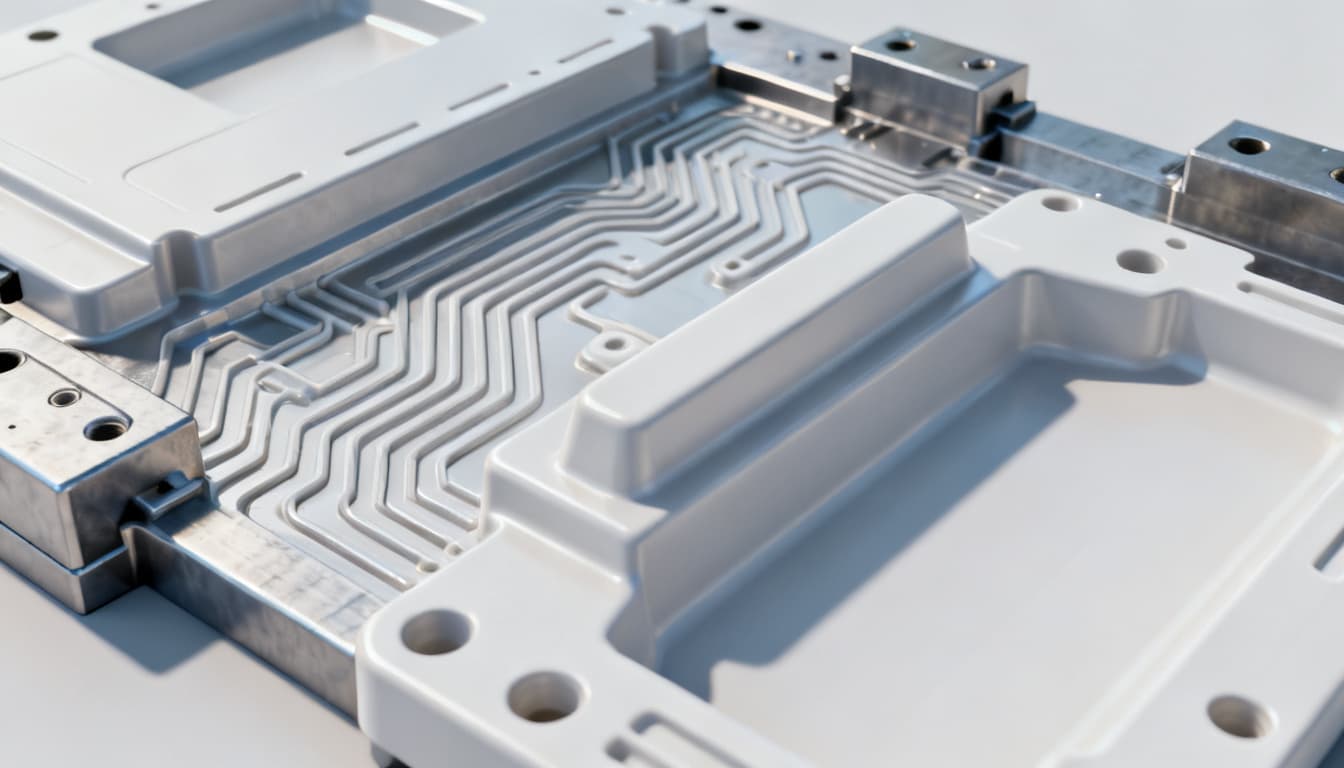
Cutting Optics Molding Costs by 18%: How Optimized Runner Systems and Faster Cycles Impact Your Bottom Line
Every year, injection molding operations across the globe lose more than $20 billion to defective parts—warped components, short shots, sink marks, and contamination that scrap entire production runs [1]. For optical components, the financial sting is even sharper. A single rejected polycarbonate le
The $20 Billion Defect Problem That Makes Optics Molding Cost-Critical
Every year, injection molding operations across the globe lose more than $20 billion to defective parts—warped components, short shots, sink marks, and contamination that scrap entire production runs [1]. For optical components, the financial sting is even sharper. A single rejected polycarbonate lens or light-pipe doesn’t just waste material; it erases the value of precision tooling, extended cycle times, and the ultra-clean processing environment that optics demand. When you factor in the cost of optical-grade surface finishes—which require specialized machining, longer lead times, and tighter process control [3]—the margin pressure becomes relentless.
Yet the industry is fighting back with data. AI-driven quality control systems are now cutting defect response times from 50 minutes to under 5 minutes and reducing scrap rates by over 90% [2]. Manufacturers are coupling that intelligence with KPI-driven rejection control that tracks in-process defects in real time [4]. These advances set the stage for a more fundamental cost lever: the runner system. Optimizing how molten plastic travels from the injection unit to the cavity can slash per-part cost by 18% or more—without touching the optical design itself. That’s the number we’ll unpack, and it’s grounded in the physics of material flow, cooling, and scrap elimination.
How Runner Design Dictates Cycle Time, Material Waste, and Optical Quality
In any injection mold, the runner system is the network of channels that conveys melt from the sprue to the gate. In a cold-runner mold, that channel solidifies along with the part, creating a rigid sprue and runner that must be ejected, reground (if permitted), or discarded. A hot-runner system keeps the melt molten right up to the gate, eliminating the solidified runner entirely. The choice between these two architectures ripples through every cost driver that matters for optical molding: cycle time, material yield, melt consistency, and the ability to hold micron-level tolerances without birefringence or flow marks.
Cold runners add mass that must cool before ejection. That extra cooling time—often 20–35% of the total cycle—directly inflates part cost. The solidified runner also represents material that cannot become a saleable lens; even if reground, optical applications almost always prohibit recycled content because of contamination and viscosity shifts. Hot runners remove both penalties, but they introduce higher tooling cost and a maintenance burden that must be justified by production volume. The table below quantifies the trade-offs that every optics project must evaluate.
| Parameter | Cold-Runner System | Hot-Runner System | Impact on Optical Molding |
|---|---|---|---|
| Runner scrap generation | Solidified runner per shot; 20–50% of shot weight wasted | Zero runner scrap; only part weight injected | Eliminates regrind risk and material cost for high-purity optical resins |
| Cycle time | Longer cooling phase limited by thickest runner section | 10–35% faster cycles; cooling limited only by part geometry | Higher throughput directly reduces per-part fixed cost |
| Melt consistency | Pressure drop across cold runner can cause shear variation and temperature gradients | Precise thermal control maintains uniform melt temperature and viscosity | Critical for minimizing birefringence and flow-induced stress in transparent parts |
| Gate freeze-off control | Gate solidifies with runner; limited independent control | Valve gates or thermal gates allow sequenced filling and precise freeze timing | Enables multi-cavity balancing and cosmetic gate vestige control |
| Maintenance complexity | Simple, no heated components; easy to clean | Requires heater, thermocouple, and manifold maintenance; potential for leakage | Downtime risk increases but manageable with preventive schedules |
| Initial tooling cost | 20–40% lower than equivalent hot-runner mold | Higher upfront investment; manifold and control system add $5,000–$20,000+ | Payback analysis essential; high-volume optics typically favor hot runners |
| Material waste | High; runner mass lost unless reground (not allowed for optics) | Near-zero waste; only purging losses | For expensive optical-grade PC or COC, material savings alone can justify hot runner |
| Suitability for high-clarity optics | Possible with optimized cold-runner design and virgin material only | Preferred; superior melt quality and repeatability | Hot runner is the default for precision lenses, light guides, and AR/VR optics |
These characteristics aren’t theoretical. The European Commission-sponsored Production 4μ project developed a tool that calculates optics production costs across the complete process chain—from glass grinding to plastic injection molding—and it consistently shows that runner architecture is a top-three cost lever [5]. When you couple that model with design standards that mandate mold flow analysis before finalizing runner and gate dimensions [6], you move from guesswork to a predictable cost structure.
Tip: Even with a cold-runner system, fine-tuning runner diameter and length through mold flow simulation can shave 5–10% off cycle time and reduce pressure drop. But to reach the 18% total cost reduction target, the hot-runner path is usually necessary.
Hot Runner vs. Cold Runner for Optics: A Side-by-Side Cost Breakdown
When an optical program moves from prototype to production, the runner decision becomes a financial equation. Cold-runner molds are undeniably cheaper to build—often 20–40% less than a hot-runner equivalent—but that advantage erodes as volumes climb [7]. Hot-runner molds, while more expensive upfront, deliver tighter tolerances, shorter lead times, and zero runner scrap [8]. The matrix below translates these differences into the metrics that procurement teams and engineering leads actually track.
| Comparison Metric | Cold-Runner System | Hot-Runner System | Selection Criteria & Failure Boundary |
|---|---|---|---|
| Upfront tooling cost (typical 8-cavity optic mold) | $30,000–$60,000 | $45,000–$90,000 | Choose cold runner if annual volume < 50,000 parts; above that, hot runner ROI accelerates |
| Per-part material cost (optical PC, $4–6/kg) | $0.12–$0.30 higher due to runner waste | Material cost limited to part weight only | Material price spikes make hot-runner savings more compelling |
| Typical cycle time reduction vs. cold runner | Baseline | 20–35% faster | Thin-wall optical parts benefit most; thick lenses see smaller gains |
| Scrap rate (optical defects) | 2–5% typical; higher if regrind contamination occurs | 1–2% with proper process control | Scrap reduction alone can cover hot-runner maintenance cost |
| Tolerance capability (lens centration, thickness) | ±0.05–0.10 mm achievable | ±0.02–0.05 mm routinely held | When optical design demands <0.05 mm, hot runner is strongly preferred |
| Maintenance frequency | Minimal; clean runner stripper plates | Preventive every 500,000–1,000,000 cycles; tip and heater replacement | Factor $1,500–3,000/year maintenance into TCO |
| Payback volume (break-even) | N/A | 50,000–100,000 parts/year for most optical lenses | Use Production 4μ-style cost model to confirm for your specific part |
| Impact of undercuts (complexity tax) | Adds 15–30% to mold cost per slider/lifter | Same complexity tax applies; hot-runner mold still carries higher base cost | Eliminate undercuts in DFM to avoid compounding tooling expense [3] |
The 18% cost reduction target isn’t a marketing slogan—it materializes when you combine the material savings from zero runner scrap (often 8–12% of part cost) with a 20–30% cycle time reduction (another 6–10%). The exact split depends on resin price and machine rate, but the math consistently favors hot runners for optical volumes above the break-even threshold. System-level cost optimization tools, like the one developed under the Production 4μ project, let you model these variables with your actual part geometry and regional machine-hour rates [5].
Key Takeaway: If your optical part carries a complexity tax from undercuts, address that first in DFM—removing a single slider can save 15–30% on tooling [3]. Then optimize the runner system to capture the full 18%.
From DFM to Mold Flow: How to Specify Runner Systems for Cost-Effective Optical Parts
Achieving that 18% cost reduction requires more than selecting “hot runner” on a purchase order. It demands a disciplined engineering workflow that starts in the design phase and continues through process validation. The following steps are what we apply at PandaMolding for every optical project—and they’re directly aligned with the industry’s most respected design guidelines [9].
- Mandate mold flow analysis before gate and runner dimensioning. Reputable mold makers and material suppliers will not specify runner or gate sizes without a mold flow study [6]. For optics, the analysis must predict shear rate, pressure distribution, and cooling uniformity to avoid birefringence and residual stress.
- Select the gate type for optical clarity. The gate is where melt enters the cavity, and its design directly influences flow marks, gate blush, and molecular orientation. The table below summarizes the gate options that work for transparent optics.
- Eliminate undercuts early in DFM. Every slider or lifter adds a 15–30% “complexity tax” to the mold cost [3]. Redesigning the part to avoid undercuts—without sacrificing optical function—is the single fastest way to reduce tooling budget and simplify runner layout.
- Leverage AI-driven process monitoring to sustain gains. Once the optimized mold is running, AI quality systems can detect process drift in seconds, not hours, keeping scrap rates below 1% [2]. Pair this with in-process rejection KPIs that track defects per million shots, and you create a closed loop that protects your 18% savings [4].
- Validate cost models against baseline data. Use the same cost-calculation methodology as the Production 4μ tool to compare predicted savings with actual per-part cost over a full production run. Track cycle time, material consumption, scrap rate, and tool maintenance expense. If the numbers don’t align, revisit mold cooling or gate design before scaling up.
| Gate Type | Advantages for Optics | Disadvantages | Best Application |
|---|---|---|---|
| Valve gate (hot runner) | Excellent gate vestige control; sequential filling reduces weld lines; fast freeze-off | Higher cost; requires precise valve pin timing and maintenance | Multi-cavity lenses, thick-wall light guides, AR/VR optics |
| Thermal pin-point gate (hot runner) | Small gate diameter minimizes gate mark; good for thin-wall parts | Risk of stringing or drool if thermal control drifts; less positive shut-off than valve gate | Thin transparent covers, small lenses, sensor windows |
| Cold pin-point gate (three-plate mold) | Lower tooling cost; automatic degating; no heated components | Runner scrap still generated; longer cycle time; limited to smaller parts | Low-volume optical prototypes or where budget prohibits hot runner |
| Edge/tab gate (cold runner) | Simple, low-cost; can be placed on non-critical edge | Gate vestige requires post-machining; high shear at gate can cause flow marks and birefringence | Non-imaging optics where gate area is hidden or machined off |
Process control is the thread that ties all these steps together. The Mastip technical manual emphasizes that a hot-runner system’s real value is the “increased process control for fine tuning of mold and part” [10]. That fine-tuning—balancing cavity fill, adjusting gate freeze time, and maintaining a stable thermal profile—is what turns a good optical part into a cost-optimized one.
Optics Molding Cost FAQ: Runner Systems, Cycle Times, and Real Savings
Q: At what production volume does a hot runner system pay back the higher tooling cost for optical lenses?
The break-even typically falls between 50,000 and 100,000 parts per year, but the exact number depends on material price, cycle-time savings, and machine-hour rate. For expensive optical resins like COC or high-purity polycarbonate, the material savings alone can push payback below 50,000 units. A detailed cost model using the Production 4μ calculator—or an equivalent in-house tool—will confirm the break-even point for your specific part geometry and regional costs [5].
Q: Can I reuse cold-runner regrind in optical-grade parts without degrading clarity?
Generally no. Regrind introduces contaminants, viscosity shifts, and black specks that cause optical defects such as haze, birefringence, and visible particles. Most optical applications require 100% virgin material, which makes the hot-runner’s zero-runner-waste characteristic a major cost advantage. If regrind is attempted, it must be tightly controlled and validated through rigorous optical testing—a risk most high-volume programs avoid entirely.
Q: How much cycle time reduction can I realistically expect from switching to a hot runner for a polycarbonate lens?
A 20–35% reduction is common because you eliminate the cooling time associated with the cold runner and benefit from faster gate freeze-off. Precise gains depend on part geometry, wall thickness, and mold cooling design. Thin-wall lenses (under 2 mm) often see the higher end of that range, while thick cross-sections may yield closer to 15–20%. Mold flow simulation will provide a part-specific estimate.
Q: What gate design minimizes flow marks and birefringence in transparent optics?
Valve gates or properly sized pin-point gates with optimized land length and diameter are the go-to solutions. Valve gates offer positive shut-off and sequential filling that reduces weld lines and orientation stress. Pin-point gates, when validated by mold flow analysis, can minimize shear stress by controlling the gate freeze time and melt temperature. The key is to keep shear rates below the material’s critical threshold for molecular orientation [6].
Q: Is it worth retrofitting an existing cold-runner mold to a hot runner for cost savings?
Retrofitting is possible but often requires extensive modifications to the manifold pocket, wiring channels, and gate inserts. The payback depends on remaining production volume and the cost of a new hot-runner mold versus modification. If the mold has several years of production ahead and the cycle-time and material savings exceed the retrofit cost within 12–18 months, it can be justified. Always perform a cost-benefit analysis using current cycle-time and scrap data before cutting steel.
Q: How do I validate that my runner optimization actually hit the 18% cost target?
Track per-part cost including cycle time, material usage, scrap rate, and tool maintenance over a full production run—ideally 100,000+ shots. Use KPI dashboards that capture real-time rejection data and compare against baseline data from mold flow simulation and initial sampling runs [4]. If the 18% isn’t materializing, examine gate freeze time, cooling uniformity, or material drying—small deviations in optical molding can erase hard-won savings.
Runner optimization isn’t a one-time event; it’s a continuous discipline. When combined with AI-driven defect detection and rigorous DFM, it becomes the most reliable path to double-digit cost reduction in optical injection molding. At PandaMolding, we’ve helped product engineers and procurement teams capture those savings without compromising the clarity or precision their designs demand. Get in touch to run the numbers on your next optical project.
References & Further Reading
- AI-Driven Injection Molding: How Machine Learning Is Cutting Defect Rates By 2025 – Topworks Plastic Molding
- Injection Molding Trends 2026: What Manufacturers Need to Know – EvokPoly
- Injection Molding Cost Breakdown: A 2026 Pricing & DFM Strategy Guide – RapidDirect
- Selection of KPI for In-Process Rejection – Vijayakumar P. (LinkedIn)
- Cost optimization of optical designs – SPIE
- Injection Mold Runner Design, Gate Design Guideline – Upmold
- Hot-Runner vs. Cold-Runner Systems – Vital Plastics
- Hot Runner vs. Cold Running Molds: Differences and Comparison – Xometry
- Injection Mold Specifications & Plastic Mold Design Guideline – Upmold
- Hot Runner Systems TECHNICAL MANUAL CATALOGUE – Mastip