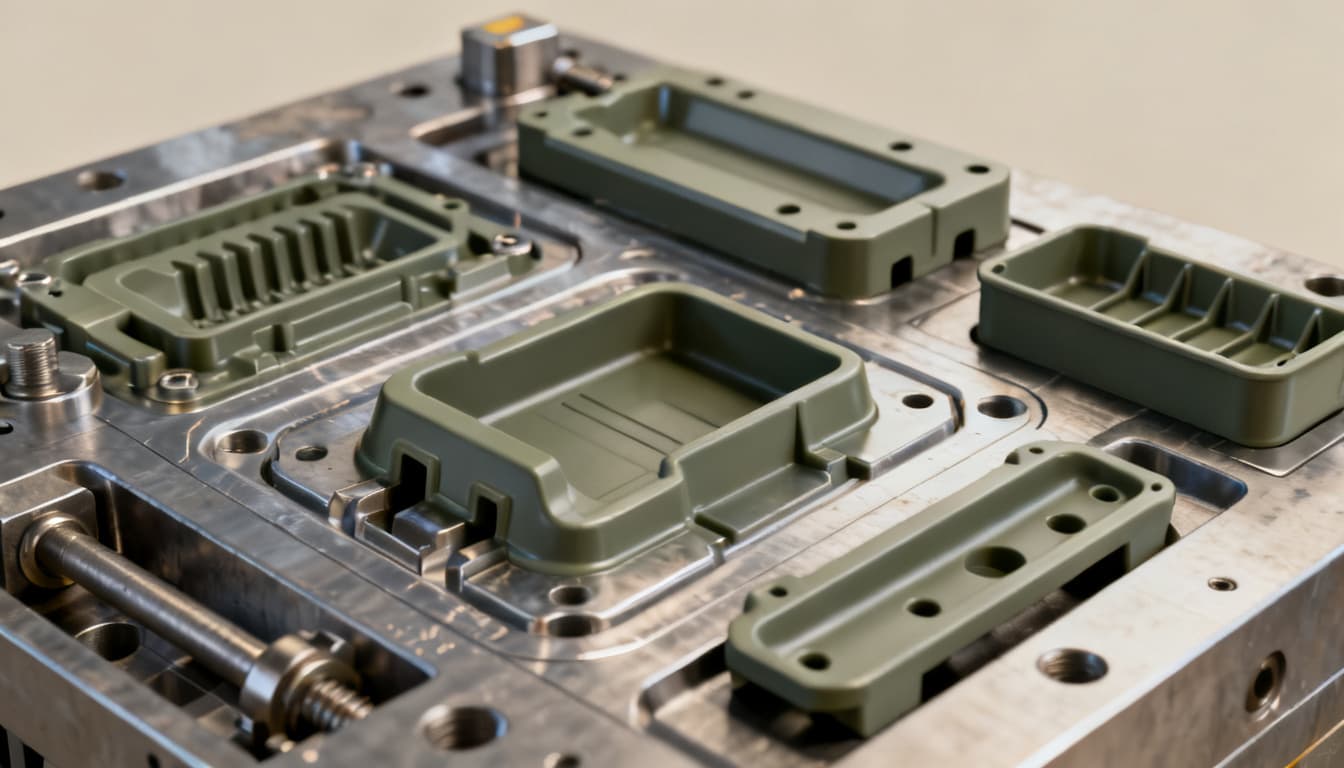
Defense-Grade Injection Molding: 2026 Best Practices for MIL-SPEC Compliant Components and Supply Chain Security
If you’re sourcing injection molded components for a defense program in 2026, you already feel the squeeze. It’s no longer enough to deliver parts that meet the print. Your supply chain must survive a cyberattack, a trade embargo, a single-source material shortage, and an audit that traces every pel
Why Defense Injection Molding Supply Chains Are Under New Pressure in 2026
If you’re sourcing injection molded components for a defense program in 2026, you already feel the squeeze. It’s no longer enough to deliver parts that meet the print. Your supply chain must survive a cyberattack, a trade embargo, a single-source material shortage, and an audit that traces every pellet of resin back to its lot number. Three forces are tightening the vise: geopolitical friction that disrupts raw material flows, reshoring mandates written into the latest National Defense Authorization Act, and DFARS clauses that penalize foreign dependency. Midwest Mold captures the shift well, noting that defense injection molding has evolved into a scalable, cost‑effective solution for complex plastic components—but only when the molder’s quality system is built for the mission.
Supply chain security now reaches all the way to the packaging bench. EDCO Supply’s compliance guide underscores that even the box and label must conform to DOD packaging codes, or the shipment gets rejected at the dock. For engineering and procurement leads, the message is clear: the bar for “defense‑grade” has risen, and the molder you choose either clears it on the first article or costs you months of schedule slip.
What 'MIL‑SPEC' Actually Means for Thermoplastic Parts
“MIL‑SPEC” isn’t a single material grade. It’s a system of specifications that governs everything from the resin’s specific gravity to the environmental test regimen the finished part must survive. For injection molded thermoplastics, the relevant documents typically include a material specification (MIL‑PRF), a test method standard (MIL‑STD‑810 for environmental conditions), and often an ASTM method like ASTM D792‑20 for specific gravity. Daisy Data’s MIL‑SPEC terminology reference explains that each type of military application pulls its own subset of requirements—what works for a cockpit display may be overkill for a ground vehicle bracket.
In practice, the material callout on your drawing will reference a MIL‑PRF number that locks in the resin chemistry, filler content, and minimum physical properties. Process controls then ensure lot‑to‑lot consistency. Matric’s work on MIL‑STD electronics highlights how parameters like dielectric thickness and copper clearance matter for PCB housings, but the same discipline applies to any defense part: you validate the process, not just the part.
Common Defense‑Grade Resins and Their MIL‑SPEC Callouts
| Resin | Typical MIL‑SPEC Reference | Continuous Service Temp (°C) | Flammability (UL 94) | Density per ASTM D792 (g/cm³) | Key Advantage |
|---|---|---|---|---|---|
| PEEK (Polyetheretherketone) | MIL‑PRF‑46183 | 260 | V‑0 | 1.30–1.32 | Low outgassing, exceptional chemical resistance |
| Ultem (PEI) | Often specified via ASTM D5205; may invoke MIL‑PRF‑81329 for polyimide variants | 170 | V‑0 | 1.27 | High strength‑to‑weight, stable dielectric properties |
| PPS (Polyphenylene Sulfide) | MIL‑PRF‑46174 | 200–220 | V‑0 | 1.35 | Inherent flame retardance, broad chemical resistance |
| LCP (Liquid Crystal Polymer) | Often meets MIL‑PRF‑85570 for connector bodies | 240–280 | V‑0 | 1.40–1.85 | Thin‑wall capability, near‑zero moisture absorption |
| PAI (Torlon) | AMS3670 or customer‑specific MIL‑PRF | 260 | V‑0 | 1.41 | Creep resistance at elevated temperature |
The table isn’t a menu—it’s a starting point. A part that must survive 500 hours of salt fog per MIL‑STD‑810 will demand more than a V‑0 rating. Your molder should walk you through the full qualification cascade before the steel is cut.
MIL‑SPEC vs. Commercial‑Grade Injection Molding: When the Extra Cost Is Justified
Onlinecomponents.com’s analysis puts it plainly: MIL‑SPEC components are “probably better” for their intended applications because they must meet defense department standards that commercial parts never face. That doesn’t mean every bracket on a ground vehicle needs a full MIL‑PRF pedigree. But when a failure could disable a weapon system or expose sensitive electronics, the premium buys more than a stamp—it buys documented process control, full material traceability, and a paper trail that survives an audit.
Molders who specialize in defense work often find ways to offset the cost delta. JG Plastics describes redesigning parts to make them lighter, stronger, and more cost‑effective while still exceeding the spec. Overmolding and insert molding can consolidate assemblies, reducing both part count and inspection burden. The table below contrasts the two tiers so you can decide where the line belongs on your program.
| Metric | MIL‑SPEC Injection Molding | Commercial‑Grade Molding | Selection Criteria |
|---|---|---|---|
| Dimensional tolerance | Typically ±0.05 mm or tighter, validated by first article inspection per AS9102 | ±0.1 mm common, with standard in‑process checks | Choose MIL‑SPEC when mating parts have zero‑backlash requirements or thermal cycling is extreme |
| Material certification | Full lot traceability to resin batch, with certified test reports per MIL‑PRF | Generic certificate of conformance; batch traceability optional | Mandatory for flight‑critical or safety‑critical components |
| Process validation | PPAP Level 3, documented process parameters, capability studies | Basic dimensional report; PPAP only if customer requires | Required when the contract invokes AS9100 or DFARS quality clauses |
| Quality system | AS9100 or ISO 9001:2015 with defense‑specific addenda | ISO 9001:2015 (often without aerospace supplements) | Primes will mandate AS9100; sub‑tier suppliers may accept ISO 9001 with a robust internal audit program |
| Cybersecurity / digital thread | ITAR‑registered network, CMMC Level 2 compliance emerging | Standard commercial IT security | Any part with export‑controlled technical data demands ITAR hygiene |
| Typical cost premium | 20–50% over commercial, driven by documentation and testing | Baseline | Justified when the cost of a field failure exceeds the premium by orders of magnitude |
| Lead time impact | Adds 2–6 weeks for material qualification and FAI | Standard tooling lead times | Plan for the delta early; rush fees can compress but not eliminate it |
The cost conversation shifts when you consider lifecycle cost. A commercial part that creeps under load or embrittles after 18 months in the sun generates a replacement order, a maintenance action, and possibly a safety investigation. The MIL‑SPEC route front‑loads the engineering but flattens the total ownership curve.
Sourcing Defense Injection Molded Parts: 5 Pitfalls That Delay First Article Approval
Even seasoned teams trip over the same obstacles. Here are five pitfalls that turn a 12‑week tooling lead time into a six‑month approval slog—and how to avoid them.
- Incomplete PPAP documentation. A Level 3 PPAP submission for a defense part isn’t a dimensional report with a cover sheet. It demands material certs, process flow diagrams, control plans, gage R&R studies, and appearance approval reports. Missing any element stops the clock. Before cutting steel, agree with your molder on the exact PPAP checklist tied to the contract’s quality clauses.
- Selecting a molder without ITAR registration. If your part or its technical data package falls under the US Munitions List, the molder must be ITAR registered. Even when the part itself is not ITAR‑controlled, many primes require registration as a supply chain safeguard. Verify the molder’s active registration and their internal procedures for handling export‑controlled data.
- Underestimating tooling lead times for exotic materials. PEEK, PPS, and glass‑filled Ultem chew through standard tool steels faster than unfilled polypropylene. Molds often need hardened inserts, high‑temperature hot runner systems, and tighter venting. A tool that would take eight weeks in P20 steel may need 14 weeks when built for a 400°C melt. Build that cushion into your master schedule.
- Neglecting cybersecurity in the digital thread. The mold flow analysis, the 3D model, the inspection data—all of it travels across networks. If your molder’s IT environment can’t meet the emerging CMMC Level 2 controls, your program office may reject the supplier outright. Ask for a System Security Plan before you send the first CAD file.
- Failing to plan for secondary ops like EMI shielding. Many defense housings need conductive coatings, vacuum‑metalized layers, or insert‑molded gaskets to meet EMI/EMC requirements. These secondary processes add lead time and introduce new failure modes. Bring the shielding vendor into the conversation during mold design, not after the first shots are off the press.
Navigating MIL‑DTL, DFARS, and the Paper Trail That Secures Your Supply Chain
The documentation hierarchy can feel like alphabet soup, but it’s the backbone of supply chain security. At the top sit the military detail specifications (MIL‑DTL) and performance specifications (MIL‑PRF) that define what the part must do and how to prove it. Below them are the packaging codes and labeling standards that ensure the part arrives in mission‑ready condition. EDCO Supply’s guide walks through the MIL‑SPEC packaging codes that govern everything from barrier bags to pallet patterns, while the Defense Standardization Program (DSP) maintains the master library of active specifications.
DFARS clauses add another layer. A contract may invoke DFARS 252.225‑7009, which restricts specialty metals, or 252.225‑7012, which mandates domestic preference for certain items. Even when the part is all‑plastic, the presence of a brass insert can trigger a compliance obligation. Your molder must be able to trace the origin of every subcomponent and provide the paperwork to prove it.
Key Documentation Elements for a Defense Injection Molding PO
| Document | Purpose | Typical Standard Reference | Format |
|---|---|---|---|
| Certificate of Conformance (C of C) | States that parts meet all drawing and spec requirements | Contract‑specific; often references MIL‑DTL | Signed letter, traceable to PO and lot numbers |
| Material certifications | Proves resin meets the MIL‑PRF or ASTM callout | MIL‑PRF‑46183, ASTM D792, etc. | Mill test reports with batch numbers |
| First Article Inspection Report (FAI) | Validates that the production process yields conforming parts | AS9102 | Form 1, 2, and 3 with ballooned drawing |
| Process parameter sheets | Records melt temperature, injection pressure, cycle time, etc. | Internal quality system | Logged per mold cavity, signed by operator |
| DFARS‑compliant packaging labels | Meets military shipping and identification requirements | MIL‑STD‑129 | Barcode labels with NSN, contract number, and lot |
| PPAP submission (Level 3) | Full production part approval package | Customer‑specific; often mirrors AIAG PPAP | Binder or electronic package with 18+ elements |
A Certificate of Conformance alone is never enough for a defense program. It’s the summary, not the evidence. Auditors will dig into the material certs, the FAI reports, and the process logs. If your molder can’t produce those records within 24 hours of a request, you’re carrying the risk.
Defense Injection Molding: 6 Questions Engineering and Procurement Teams Ask Before RFQ
Q: How do lead times for defense‑grade PEEK parts compare to Ultem?
PEEK typically adds 2–4 weeks to the molding schedule because it processes at melt temperatures above 360°C, requires longer cooling cycles, and demands hardened tooling. Ultem (PEI) cycles faster and can often run in standard high‑temperature molds, but parts may need a post‑cure step to lock in dimensional stability. If your timeline is tight, Ultem can shave weeks off the critical path—provided the service temperature and chemical exposure allow the substitution.
Q: Is ITAR registration mandatory for injection molders making MIL‑SPEC components?
If the part or its associated technical data appears on the US Munitions List, the molder must be ITAR registered. Even when the component itself is not ITAR‑controlled, many prime contractors require registration as a supply chain safeguard, because the mold design or process parameters may reveal defense‑related information. Always confirm the molder’s registration status and their internal controls for handling export‑controlled data before releasing a drawing package.
Q: What is the minimum order quantity for custom MIL‑SPEC molded parts?
It varies by molder and tooling strategy. Some shops support low‑volume production (100–500 units) using aluminum prototype tooling or MUD inserts, which keeps upfront cost manageable. For high‑volume steel tools, the amortization math usually requires 5,000‑plus pieces. Discuss your annual forecast honestly; a molder that understands your program’s lifecycle can propose a tooling approach that balances unit price and commitment.
Q: Can a commercial‑grade resin be upgraded to meet MIL‑SPEC with additives?
In limited cases, adding flame retardants, UV stabilizers, or glass fiber can nudge a commercial resin closer to a MIL‑PRF profile. However, full compliance typically demands a pre‑certified compound whose formulation is locked and tested. Introducing additives post‑hoc changes the material’s processing behavior and may void the UL listing. Always validate the modified material with a first article test per the applicable MIL‑PRF before committing to production.
Q: How do I audit a potential injection molder’s quality system for defense work?
Start with the certificates: AS9100 is the gold standard; ISO 9001:2015 is the minimum. Then dig into the documented procedures. Ask for a sample first article inspection report completed per AS9102, and review how the molder handles non‑conformances and corrective actions. On‑site, check tool maintenance logs, material traceability records, and the segregation of defense work from commercial jobs. A molder that hesitates to show you the shop floor probably isn’t ready for a defense audit.
Q: What documentation is typically required to close out a defense injection molding PO?
The standard package includes a Certificate of Conformance, material certifications traceable to lot numbers, dimensional inspection reports for each cavity, process parameter sheets, and DFARS‑compliant packaging labels per MIL‑STD‑129. Some contracts also require a completed PPAP Level 3 submission and a first article inspection report. The exact set is defined by the quality clauses in your contract—review them with your molder before the first shot, not after the last shipment.
References & Further Reading
- Plastic Injection Molding Trends in Aerospace and Defense – Midwest Mold – Overview of how defense injection molding is scaling to meet complex requirements.
- Mil‑Spec Packaging Codes & DOD Compliance Guide – EDCO Supply – Detailed breakdown of military packaging and labeling requirements.
- MIL Specifications – CableOrganizer – Includes ASTM D792‑20 context for specific gravity testing of molded materials.
- MIL‑SPEC Ratings and Terminology – Daisy Data Displays – Explains how defense specifications apply to different military applications.
- What Is MIL‑STD in Military Electronics? – Matric Blog – Insights on MIL‑STD‑compliant electronics and the associated process controls.
- Are MIL‑SPEC Components Better Than “Regular” Components? – Onlinecomponents.com – Analysis of when MIL‑SPEC adds value.
- Defense – Military – Tactical Injection Molding – JG Plastics – Case studies on redesigning parts to exceed specs while reducing cost.
- Defense Standardization Program Specifications and Standards – DSP – Official repository for active military specifications and standards.
The right injection molder doesn’t just fill a mold—it secures your supply chain from resin lot to packaging label. If your next program demands defense‑grade traceability, ITAR‑compliant data handling, and first‑article approval without drama, reach out to our engineering team to discuss your requirements.