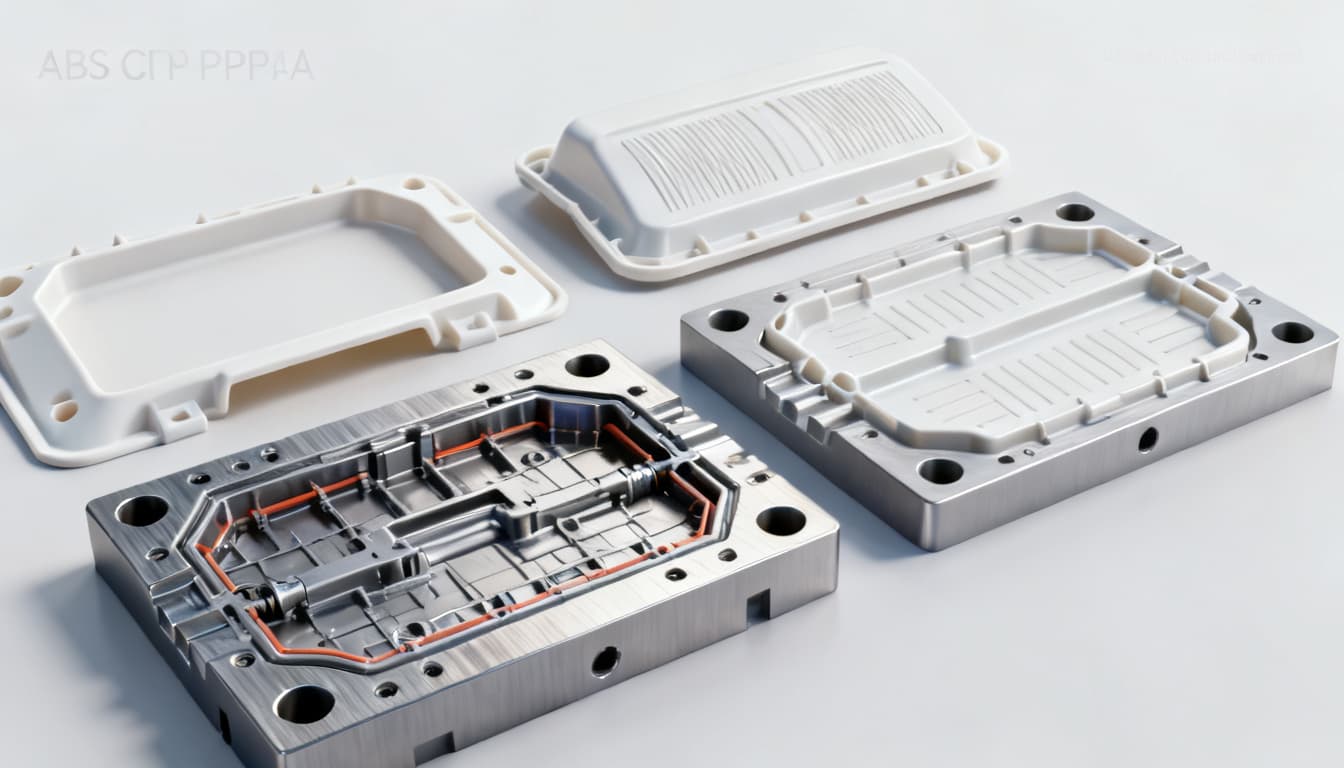
How to Select the Right Plastic: A Step-by-Step Guide for ABS, PC, PP, and PA
Most engineers start a material selection conversation by pulling up a datasheet and comparing tensile strength and heat deflection temperature. That is necessary—but it misses the larger picture. The resin you choose ripples into mold design, cycle time, part cost, and supply-chain stability in way
How to Select the Right Plastic for Injection Molding: A Step-by-Step Guide to ABS, PC, PP, and PA
Why Your Choice Among ABS, PC, PP, and PA Determines More Than Mechanical Properties
Most engineers start a material selection conversation by pulling up a datasheet and comparing tensile strength and heat deflection temperature. That is necessary—but it misses the larger picture. The resin you choose ripples into mold design, cycle time, part cost, and supply-chain stability in ways that a UL Yellow Card will never reveal.
I have walked into too many tooling review meetings where the material was treated as a fixed variable—something the designer picked six months ago and nobody questioned. By then, the mold steel was already cut, and the only remaining lever was processing. That is an expensive place to discover that your chosen resin shrinks twice as much as the alternative, or that it needs four hours of drying before every production run, or that its price just spiked because of a force majeure at a monomer plant.
According to Plastics Technology, injection molders and OEM buyers have been re-evaluating standard material selections more aggressively in the past two years than at any point in the previous decade. Resin price volatility, shifting availability of glass-fiber-reinforced grades, and pressure to reduce cycle times are driving a fresh look at the workhorse thermoplastics: ABS, PC, PP, and PA. The question is no longer "which material meets the spec?" but "which material meets the spec and keeps the project on budget, on time, and out of the failure-analysis lab?"
Key Takeaway: Material selection is a system-level decision. Change the resin, and you change the mold design, the processing window, the quality-control protocol, and the part's long-term field performance. The four resins covered here account for a substantial share of all injection-molded parts produced globally. Understanding their trade-offs—not just their datasheet numbers—is what separates projects that ship on time from those that burn budget on tool rework.
The Four Resins at a Glance: Properties That Shape Your Injection Molding Outcome
Before diving into head-to-head comparisons, you need a clear picture of what each material brings to the molding machine. The table below consolidates the properties that matter most during mold design, process development, and part validation. All values are for unfilled, general-purpose grades; glass-fiber or impact-modified variants will shift these numbers, sometimes dramatically.
| Property | ABS | PC | PP | PA6 / PA66 | Unit |
|---|---|---|---|---|---|
| Density | 1.03 – 1.07 | 1.20 – 1.22 | 0.90 – 0.91 | 1.13 – 1.15 | g/cm³ |
| Tensile Strength (Yield) | 35 – 50 | 55 – 75 | 25 – 40 | 60 – 85 (dry) | MPa |
| Flexural Modulus | 2.0 – 2.8 | 2.2 – 2.5 | 1.0 – 1.8 | 2.5 – 3.5 | GPa |
| Notched Izod Impact (23°C) | 150 – 400 | 600 – 850 | 50 – 200 | 50 – 150 (dry) | J/m |
| Heat Deflection Temp (0.45 MPa) | 90 – 100 | 130 – 140 | 80 – 100 | 150 – 190 | °C |
| Mold Shrinkage | 0.4 – 0.9 | 0.5 – 0.7 | 1.5 – 2.5 | 0.8 – 1.8 | % |
| Moisture Absorption (24 hr) | 0.2 – 0.4 | 0.15 – 0.35 | < 0.01 | 1.5 – 2.5 | % |
| Drying Required | Yes (2–4 hr @ 80°C) | Yes (3–4 hr @ 120°C) | No (typically) | Yes (4–6 hr @ 80°C) | — |
| Relative Resin Cost | Low – Medium | Medium – High | Low | Medium | — |
| Typical Cycle Time Factor | 1.0 (baseline) | 1.2 – 1.4× | 0.7 – 0.9× | 0.9 – 1.1× | — |
What this table does not show—and what every experienced molder knows—is how these properties interact on the shop floor. ABS delivers an exceptional balance of rigidity, impact resistance, and surface aesthetics at a moderate cost. It paints and plates beautifully, which is why you see it everywhere from automotive interior trim to consumer electronics housings. PC brings optical clarity and outstanding impact strength, but it demands higher melt temperatures, longer drying, and more expensive tool steel to resist its slightly corrosive nature at processing temperatures. PP is the lightweight, chemical-resistant workhorse that costs less per pound than almost anything else in the thermoplastics family, but its high and anisotropic shrinkage makes precision tooling a challenge. PA—both PA6 and PA66—offers strength and fatigue resistance that rival some metals, but it drinks moisture from the air and will punish you with brittle parts and splay if you skip the dryer.
Tip: When comparing datasheets, always check whether PA tensile and impact values are reported "dry as molded" (DAM) or conditioned. The difference can be 30–50%, and it trips up engineers who are new to nylon. For more on how processing conditions affect final properties, Plastics Technology maintains an extensive database of processing guidelines that is worth consulting before finalizing any resin choice.
When to Bet on ABS Over PC, and Why PA Might Be Your PP Alternative
Datasheets tell you what a material is. The real engineering question is what a material does in your specific application—and what it costs you when it fails. The following comparison matrix maps four common design scenarios to the resin pairings that create the toughest decisions.
| Design Scenario | Option A (Primary Choice) | Option B (Alternative) | Selection Criteria & Failure Boundary |
|---|---|---|---|
| High impact + optical clarity | PC | ABS (opaque only) | Choose PC when transparency is non-negotiable and the part must survive a 1-meter drop onto concrete. ABS cannot deliver clarity; if you can accept opaque and your impact requirements are moderate, ABS saves 30–50% on resin cost. Failure boundary: switching to ABS when the part must pass UL transparency or glazing requirements. |
| Living hinge + chemical exposure | PP | PA6 | PP is the undisputed champion of living hinges—it can flex millions of cycles without cracking. It also shrugs off strong acids and bases at room temperature. PA6 offers better stiffness and fatigue resistance but will fail prematurely in a living hinge if not designed with a larger bend radius. Choose PP when hinge longevity and broad chemical resistance matter more than structural stiffness. |
| Moisture-sensitive precision part | PP | PA6/PA66 | PP absorbs essentially zero moisture, so dimensions stay stable from the mold to the field. PA can grow 0.5–1.0% in service as it absorbs water, which kills tight tolerances. Choose PP when dimensional stability in humid environments is critical. Choose PA only if you can guarantee drying and accept post-molding dimensional change. |
| Class-A painted surface | ABS | PC | ABS accepts paint and plating with minimal surface preparation. PC often needs a primer or flame treatment for reliable paint adhesion. If the part is visible and must match a color standard exactly, ABS is the lower-risk choice. Failure boundary: choosing PC for a painted exterior part without budgeting for adhesion promoters and process trials. |
| Under-hood / high-heat structural | PA66 (GF30) | PP (GF30) | When temperatures exceed 100°C and the part carries load, glass-filled PA66 is the default. PP—even glass-filled—loses stiffness rapidly above 80°C. Choose PA when heat and load coincide. Choose PP only if peak temperatures stay below 80°C and chemical resistance to aggressive fluids is the primary driver. |
Each of these pairings represents a real fork in the road that I have seen teams wrestle with during design reviews. The common thread is that the "wrong" choice is rarely wrong in an absolute sense—it is wrong for the boundary conditions of the specific application. A PA part that works beautifully in a dry Arizona warehouse may warp and fail tolerance checks in a humid Singapore factory. A PP living hinge that survives a million cycles at room temperature may creep and sag at 70°C. The datasheet will not flag these failure modes; only a disciplined selection process will.
Surface finish deserves special attention. ABS molds to a matte or high-gloss surface with minimal gate blush and excellent color consistency. PC can also achieve high gloss but is more prone to splay and streaking if drying is imperfect. For parts that will be chrome-plated, ABS is the industry standard—its butadiene phase provides etch sites that create outstanding adhesion. PC/ABS blends occupy a middle ground, offering better low-temperature impact than straight PC and higher heat resistance than straight ABS, but they can be trickier to process and may show reduced chemical resistance compared to pure PC. Validate any blend with real molding trials before committing tool steel.
A 5-Step Selection Workflow for Injection Molding Buyers and Design Engineers
Material selection is not a single decision made at a desk. It is a workflow that starts with functional requirements and ends with validated production parts. Skipping steps—especially the DFM feedback loop—is the most common cause of expensive tool revisions I see in this industry.
Step 1: Define Functional Loads and Environment
Start with the part's mechanical duty cycle and its chemical and thermal environment. Ask: What is the maximum service temperature, including short-term excursions? Will the part see impact loads, and at what temperature? Is there exposure to fuels, oils, cleaning agents, or UV radiation? Document these requirements quantitatively—"must survive a 1.5 J impact at -20°C" is actionable; "needs to be tough" is not. This step narrows your resin options from dozens to the two or three that are genuinely viable.
Step 2: Set Cost Targets Including Tooling
Resin cost per kilogram is only part of the story. A cheaper resin that requires a hotter mold, longer cooling time, or more frequent screw and barrel maintenance can erase its material-cost advantage within the first year of production. Build a simple total-cost model that includes resin price, cycle time, drying energy, scrap rate, and expected tool life. PP cycles fast and needs no drying—its total processing cost is often the lowest of the four. PC cycles slower and demands higher mold temperatures, pushing up energy cost and cycle time. ABS sits in the sweet spot for many applications: moderate cycle times, forgiving processing, and competitive resin pricing.
Step 3: Check Processability—Wall Thickness, Flow Length, and Shrinkage
Every resin has a processing personality. The table below captures the parameters that determine whether a material will fill your cavity cleanly and hold its shape during ejection.
| Process Parameter | ABS | PC | PP | PA6 | Notes |
|---|---|---|---|---|---|
| Recommended Melt Temp | 200 – 250°C | 270 – 320°C | 200 – 250°C | 230 – 280°C | Stay within supplier range to avoid degradation |
| Mold Temp | 40 – 80°C | 70 – 100°C | 20 – 60°C | 60 – 90°C | Higher mold temps improve surface finish but increase cycle time |
| Min Wall Thickness | 0.8 mm | 1.0 mm | 0.6 mm | 0.8 mm | Thinner walls increase flow resistance and may require higher injection pressure |
| Flow Length Ratio | 150 – 200:1 | 100 – 150:1 | 200 – 300:1 | 150 – 250:1 | PP flows exceptionally well; PC is more viscous and limited in thin-wall designs |
| Shrinkage Range | 0.4 – 0.9% | 0.5 – 0.7% | 1.5 – 2.5% | 0.8 – 1.8% | PP shrinkage is anisotropic—warpage risk is significantly higher |
| Ejection Difficulty | Low | Medium | Low – Medium | Medium | PC can stick; adequate draft (≥1°) is essential |
Pay particular attention to shrinkage when designing the mold. PP's high and directional shrinkage means the mold cavity must be cut larger and with different allowances in the flow and cross-flow directions. If you are switching from ABS to PP, do not simply scale the existing mold design—the shrinkage differential will produce parts that are out of tolerance, and warpage may be severe enough to require a complete tool redesign.
Step 4: Involve the Molder Early for DFM Feedback
This is the step that saves projects. A skilled injection molder reviews your part geometry, material choice, and tooling plan together—not in isolation. They will flag issues like insufficient draft for a high-shrinkage resin, wall thickness transitions that will cause sink marks in a crystalline material like PA, or gate locations that will create weld lines in a critical load path. Partnering with an experienced injection molder like Panda Molding brings manufacturing reality into the design phase, when changes cost hours instead of tens of thousands of dollars in tool rework. Early DFM engagement is the single most effective way to derisk material selection and avoid the painful cycle of mold-try- revise-repeat.
Step 5: Validate with Prototype Shots
Before cutting production steel, run prototype tools—aluminum molds or 3D-printed insert tooling—using the exact resin grade you intend for production. Check fill pattern, warpage, surface finish, and mechanical performance. Measure dimensions after 48 hours of conditioning at the expected service humidity. For PA parts, this conditioning step is non-negotiable; a part that measures perfectly right out of the press may grow measurably after absorbing ambient moisture. Prototype validation catches the gap between simulation and reality, and it gives you hard data to justify your material choice to stakeholders.
Note: Simulation software (Moldflow, Moldex3D) is valuable, but it is not a substitute for physical trials. Simulations make assumptions about material behavior that may not hold at the extremes of your processing window. Use simulation to narrow options; use prototype shots to confirm them.
Questions Engineers Ask When Switching Between ABS, PC, PP, and PA
Q: Can I replace PC with ABS to reduce cost while keeping impact strength?
Only if the impact requirements are moderate and the part does not need transparency or high heat resistance. ABS is typically 30–50% cheaper per kilogram than PC, but its notched Izod impact values are lower—especially at sub-zero temperatures, where ABS can transition to brittle behavior while PC retains ductility. ABS also has a heat deflection temperature roughly 40°C lower than PC. Before making the switch, verify the real service temperature (including short-term spikes from nearby heat sources or sun load) and run drop tests at the lowest expected operating temperature. If the part must remain transparent or pass a glazing standard, ABS is not an option—it is inherently opaque.
Q: How critical is moisture control when processing PA (nylon), and what happens if I skip drying?
Moisture control is a make-or-break factor with PA. Nylon absorbs moisture rapidly from ambient air—PA6 can pick up 0.5% moisture in under an hour of exposure in a humid environment. If you skip drying or use improperly dried resin, the water in the pellets hydrolyzes the polymer chains during melting. This permanently degrades molecular weight, producing splay (silver streaks on the part surface), brittleness, and dimensional instability. Typical drying specifications are 4–6 hours at 80°C for PA6 using a desiccant dryer. A hot-air oven is not sufficient. The damage from hydrolysis is irreversible—you cannot "dry out" a molded part and recover the lost mechanical properties. If your facility cannot guarantee consistent drying, choose PP instead.
Q: What is the real mold shrinkage difference between PP and ABS, and how does it affect tool design?
PP shrinks significantly more than ABS—1.5–2.5% versus 0.4–0.9%—and, critically, PP shrinkage is anisotropic. It shrinks more in the flow direction than in the cross-flow direction, which introduces warpage risk that is far less pronounced with amorphous ABS. This means a mold designed for PP must be cut with larger, direction-dependent allowances. If you are switching an existing part from ABS to PP, the mold cannot simply be re-cut with a uniform offset; the cavity geometry, gate location, and cooling layout must be re-evaluated to manage differential shrinkage. Always involve the mold maker early when making this switch, and budget for at least one iteration of prototype tooling to dial in the shrinkage factors.
Q: When would I choose PP over PA for a chemical-resistant application?
PP excels in strong acids, bases, and many organic solvents at room temperature, and it costs less per kilogram than any grade of PA. It also absorbs essentially no water, so its mechanical properties and dimensions remain stable in wet chemical environments. However, PP loses stiffness rapidly above 80°C and has lower tensile strength than PA. Choose PP if the chemical environment is aggressive (concentrated acids, oxidizing agents, polar solvents), the service temperature stays below 80°C, and structural stiffness is not the primary requirement. Choose PA when the application involves fuels, oils, or elevated temperatures—PA66, in particular, offers excellent resistance to hydrocarbons at temperatures up to 150°C, where PP would soften and creep. For a deeper dive into chemical compatibility data, consult the resin supplier's chemical resistance chart and cross-reference with Plastics Technology processing guides.
Q: Is a PC/ABS blend always a safe middle ground, or does it introduce new trade-offs?
PC/ABS blends are not a magic bullet. They improve low-temperature impact toughness compared to straight PC and offer better heat resistance than ABS alone, which makes them popular for automotive interior components and electronics housings that need a balance of properties. However, PC/ABS blends can be more sensitive to processing conditions—the ABS phase can degrade if melt temperatures are pushed too high to accommodate the PC phase, and the blend's chemical resistance is generally inferior to pure PC, particularly against solvents and some cleaning agents. The blend ratio matters: a 65/35 PC/ABS behaves differently from a 50/50 blend. Use PC/ABS when you genuinely need the combined property profile, not as a default compromise. Validate with real molding trials using your specific grade and part geometry before committing to production tooling.
Q: How do I validate my material choice before cutting steel for a production mold?
Run a small batch of prototype tools—aluminum molds or 3D-printed insert tooling—using the exact resin grade and color you intend for production. Evaluate fill pattern, warpage, surface finish, and mechanical performance under conditions that match the end-use environment. For PA parts, condition the samples for 48 hours at the expected service humidity before measuring dimensions. For PP parts, check for warpage and sink marks, especially at wall thickness transitions. Partner with a molder that offers design-for-manufacturing feedback during this phase; early engagement can catch issues like insufficient draft, sharp corners that create stress concentrations, or wall thickness variations that will cause differential shrinkage. Panda Molding and other experienced injection molders provide DFM reviews that identify these risks before steel is cut, saving weeks of schedule and thousands in tool rework. The cost of a prototype tool is a fraction of the cost of revising a hardened production mold.
References & Further Reading
- Plastics Technology — Injection molding industry news, processing guidelines, and material databases for thermoplastics including ABS, PC, PP, and PA.
- Panda Molding — Professional injection molding services with design-for-manufacturing support and material selection guidance.
- ASTM International — Standards including ASTM D638 (tensile properties), ASTM D790 (flexural properties), and ASTM D648 (heat deflection temperature) for thermoplastic material characterization.
- ISO — International standards for plastics testing, including ISO 178 (flexural properties) and ISO 75 (heat deflection temperature).
- Plastics Industry Association — Industry resources, market data, and supply-chain intelligence for injection molding buyers and engineers.
- Plastics Technology Processing Guides — Detailed drying, melt temperature, and mold temperature recommendations for commodity and engineering thermoplastics.
- Panda Molding — Request a Quote — Contact an experienced injection molding partner for project-specific material and tooling guidance.
Conclusion
Selecting the right plastic among ABS, PC, PP, and PA is not about finding the "best" material—it is about finding the material that aligns with your part's functional demands, your production economics, and your supply-chain reality. Each of these four resins has a distinct personality: ABS balances aesthetics and impact at a fair price, PC delivers clarity and toughness at a premium, PP offers chemical resistance and low cost with shrinkage challenges, and PA provides metal-like strength with moisture sensitivity that demands respect. The five-step workflow outlined here—define loads, set total cost targets, check processability, involve the molder early, and validate with prototype shots—turns material selection from a guessing game into a disciplined engineering decision. If you are evaluating a material switch or starting a new project, get a quote from a molder that understands the interplay between resin, tooling, and process. The right partner will save you more in avoided mistakes than any resin cost reduction ever could.