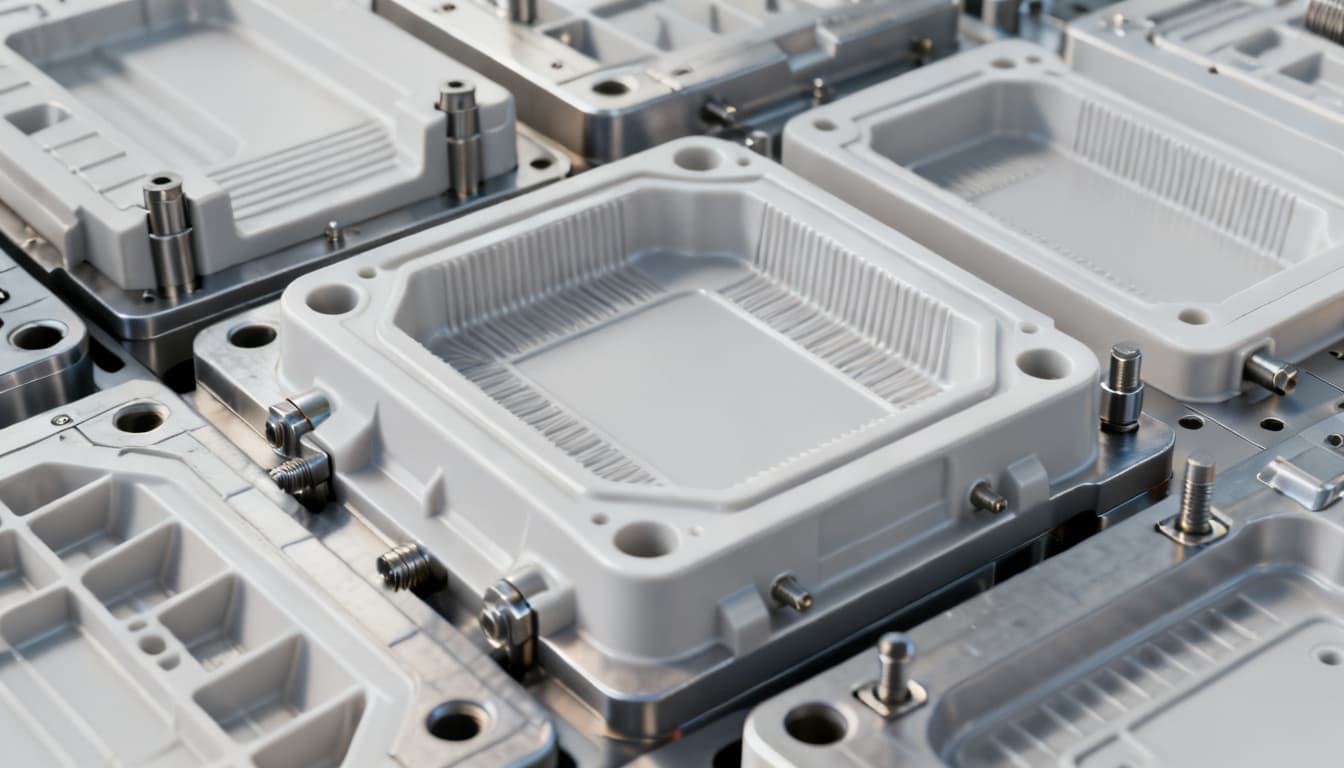
Scrap Rate Slashed: A Cost-First Approach to Solving Injection Molding’s Most Common Defects
Every rejected part is a line item on your profit-and-loss statement, but the true cost of scrap runs far deeper than the part itself. The material trapped in runners, sprues, and gates—plastic you paid for but never sell—can quietly erase the margin on an entire production run. Add machine downtime
Scrap Rate Slashed: A Cost-First Approach to Solving Injection Molding’s Most Common Defects
Every rejected part is a line item on your profit-and-loss statement, but the true cost of scrap runs far deeper than the part itself. The material trapped in runners, sprues, and gates—plastic you paid for but never sell—can quietly erase the margin on an entire production run. Add machine downtime, operator intervention, and regrind handling, and what looks like a 2% scrap rate can easily consume 8–12% of total manufacturing cost. This article takes a cost-first lens to the most common injection molding defects, showing you how to slash scrap rate by targeting the root causes that hit your bottom line hardest. We’ll draw on proven cost models, process optimization strategies, and real-world defect playbooks to help you turn waste into recovered profit.
Why Scrap Costs More Than You Think: The Hidden Price of Common Defects
When a part comes out with a sink mark or flash, the immediate reaction is often to toss it in the regrind bin and move on. But that single defective shot carries a cascade of hidden costs. First, there’s the material weight of the entire shot—not just the part, but the runner, sprue, and gate system that solidified alongside it. As Xometry’s injection molding cost breakdown illustrates, if you end up with 4 lbs of good parts and 1 lb of leftover plastic in the runner, that 1 lb is paid for but never sold. In high-volume production, this “invisible” material waste can exceed the cost of the rejected parts themselves.
Beyond material, scrap drives up processing cost per good part. Every defective cycle consumes machine time, energy, and labor without generating revenue. When defects force unscheduled stops to clean mold surfaces or adjust parameters, the ripple effect disrupts production planning and can delay entire orders. Baiwe Molding’s guide to scrap reduction emphasizes that integrating process monitoring systems catches parameter drift before it produces scrap, avoiding both material waste and downtime. The upfront cost of such systems is quickly offset by the material savings and increased machine utilization they deliver.
Regrinding defective parts adds another layer of hidden expense. While regrind can be blended back into virgin material, it often requires additional handling, drying, and quality checks to prevent contamination or viscosity shifts that cause new defects. The true cost of scrap, therefore, must account for the entire lifecycle of the wasted shot—from raw material purchase through machine time, labor, regrind processing, and the opportunity cost of lost production capacity. A cost-first mindset treats every defect as a financial leak, and the goal is to plug the biggest leaks first.
How Process Parameters Drive Defect Rates and Material Waste
Injection molding defects rarely appear at random. They are the physical manifestation of process parameters that have drifted outside the optimal window. Understanding the cause-and-effect chain between key parameters and defect types is the foundation of any scrap reduction effort. Melt temperature, injection pressure, packing/holding pressure and time, cooling rate, and mold temperature all interact to determine part quality. When one parameter is off, the result is predictable—and costly.
The table below maps the most expensive defects to the parameter mis-settings that typically cause them, along with an estimate of their relative contribution to total scrap cost in a typical multi-cavity production environment.
| Defect Type | Primary Parameter Mis-Setting | Typical Scrap Cost Contribution | Notes |
|---|---|---|---|
| Sink Marks / Voids | Insufficient packing pressure or holding time; melt temperature too high | High (20–35% of total scrap) | Often appears on thick sections; packing phase is critical |
| Warpage | Uneven cooling rate; mold temperature imbalance; inadequate packing | High (15–25%) | Dimensional instability leads to assembly failures |
| Short Shots | Low melt temperature; insufficient injection pressure; premature gate freeze-off | Medium (10–20%) | Incomplete filling; often intermittent |
| Flash | Excessive injection speed/pressure; low clamp force; worn mold parting line | Medium (10–15%) | Material escapes cavity; secondary trimming adds cost |
| Burn Marks | Trapped air/gas; excessive injection speed; inadequate venting | Low–Medium (5–10%) | Discoloration and degraded material properties |
| Weld Lines | Low melt temperature; poor gate location; insufficient injection speed | Low–Medium (5–10%) | Weakens structural integrity; often cosmetic issue |
To quantify the financial impact, Topworks Plastic Molding’s cost formula breaks down total part cost into material, processing, and scrap components:
- Material Cost = Weight (kg) × Material Price ($/kg)
- Processing Cost = (Machine Hourly Rate / 3600) × Cycle Time (s) ÷ Number of Cavities
- Scrap Cost = Base Cost × Scrap Rate ÷ (1 – Scrap Rate)
This formula reveals a non-linear relationship: a 5% scrap rate doesn’t add 5% to cost—it adds more because the denominator shrinks. For example, if base cost per good part is $1.00 and scrap rate is 5%, scrap cost per good part becomes $1.00 × 0.05 ÷ 0.95 = $0.0526, effectively a 5.26% increase. At 10% scrap, the adder jumps to 11.1%. Small parameter adjustments that reduce scrap from 5% to 2% can therefore deliver a disproportionately large margin improvement.
Tedesolutions’ research on scrap reduction highlights that packing pressure and holding time are among the most influential parameters for eliminating sink marks and voids. By extending holding time slightly or increasing packing pressure within the material’s safe range, you can often cut sink-mark-related scrap by half without any tooling changes. Similarly, optimizing mold temperature and cooling time can dramatically reduce warpage. The key is to treat parameter optimization as a continuous, data-driven process rather than a one-time setup.
Comparing Defect Fixes: Quick Process Tweaks vs. Tooling Overhauls
When defects persist, engineers face a critical decision: adjust process parameters on the existing mold, or invest in tooling modifications. Both paths have their place, and the right choice depends on defect type, production volume, and the root cause. The comparison table below evaluates the two approaches across key criteria, helping you decide when a quick tweak is sufficient and when it’s time to cut steel.
| Comparison Metric | Quick Process Tweaks (Temp, Pressure, Timing) | Tooling Overhauls (Gate Redesign, Runner Balancing, Cooling Layout) | Selection Criteria & Failure Boundary |
|---|---|---|---|
| Cost | Near-zero out-of-pocket; only machine time for trials | $2,000–$15,000+ depending on complexity | Choose tweaks first unless defect is clearly tooling-driven |
| Lead Time | Hours to days | 2–6 weeks for design, machining, and testing | Urgent production issues favor process adjustments |
| Effectiveness for Flash | High: reduce injection speed, lower melt temp, increase clamp force | Moderate: improve parting line fit, add venting; often overkill | Flash from worn tooling may require mold repair, not just parameter changes |
| Effectiveness for Weld Lines | Moderate: raise melt temp, increase injection speed, adjust mold temp | High: relocate gate to alter flow front meeting angle | If weld line location is structurally critical, tooling change pays back |
| Effectiveness for Burn Marks | Moderate: reduce injection speed, improve venting via process | High: add or enlarge vents, redesign runner to eliminate gas traps | Persistent burn marks usually indicate inadequate venting—tooling fix is permanent |
| Risk of Recurrence | Higher: parameters can drift again; requires monitoring | Lower: physical changes are permanent; less operator-dependent | Combine with process monitoring (Baiwe) to lock in gains |
Tedesolutions’ gate design optimization shows that when a gate is too small or poorly positioned, no amount of process tweaking will fully eliminate flow-related defects. In such cases, a tooling overhaul—enlarging the gate or moving it to a thicker section—can reduce scrap rate by 30% or more, delivering payback within a few production runs. On the other hand, Baiwe’s emphasis on production planning reminds us that many defects arise from cold starts, material changes, or scheduling gaps. Simple adjustments like preheating the mold, purging thoroughly between material lots, and sequencing jobs to maintain thermal stability can slash scrap without touching the tool.
Tip: Before committing to a tooling change, run a structured Design of Experiments (DOE) on process parameters. You may find that a combination of small adjustments—slightly higher mold temperature, a bit more packing pressure, and a half-second longer hold—eliminates the defect entirely. If the defect persists across a wide process window, the root cause is likely in the tool, and the investment in steel becomes justified.
From Sink Marks to Flash: A Cost-Ranked Playbook for High-Impact Defects
Not all defects are equal. A sink mark on a cosmetic surface may scrap the part, while a minor weld line on a non-structural area might be acceptable. To maximize scrap reduction per dollar spent, prioritize defects by their contribution to total scrap cost—typically a Pareto distribution where a few defect types account for the majority of waste. The playbook below ranks common defects by typical cost impact and provides actionable, parameter-first fixes, along with guidance on when to escalate to tooling changes.
| Defect (Cost Rank) | Primary Fix (Process) | Secondary Fix (Tooling if Needed) | Estimated Scrap Reduction Potential |
|---|---|---|---|
| 1. Sink Marks / Voids | Increase packing pressure and extend holding time; lower melt temperature slightly (Tedesolutions) | Enlarge gate or add a second gate to improve packing; redesign rib thickness | 20–50% reduction in sink-related scrap |
| 2. Warpage | Balance mold temperatures; optimize cooling time; reduce packing pressure if over-packed | Add conformal cooling channels; adjust wall thickness uniformity | 15–30% reduction |
| 3. Short Shots | Raise melt temperature; increase injection speed/pressure; verify gate freeze-off timing | Enlarge gate or runner; add flow leaders | 10–25% reduction |
| 4. Flash | Reduce injection speed and peak pressure; verify clamp force adequacy; lower melt temp | Refurbish parting line; improve mold alignment | 10–20% reduction |
| 5. Burn Marks | Reduce injection speed; add mold breathing (slight mold opening during injection); check vent cleanliness | Add or deepen vents; redesign runner to eliminate gas traps | 5–15% reduction |
| 6. Weld Lines | Increase melt and mold temperature; raise injection speed; adjust gate location if possible via process | Relocate gate to change flow front meeting angle; add overflow wells | 5–10% reduction (structural improvement may be higher value) |
Implementing these fixes systematically can transform your scrap rate. Start by integrating a process monitoring system that tracks cavity pressure, melt temperature, and cycle time in real time. Baiwe Molding notes that such systems pay for themselves quickly by catching drift before it produces scrap. Pair monitoring with a regular review of runner and sprue design: Xometry’s cost insights remind us that every gram of material in the feed system is a cost that can be minimized through hot runner systems or optimized cold runner layouts.
ROI Rule of Thumb: If a process adjustment eliminates a defect that was causing 3% scrap on a $500,000 annual material spend, the saving is $15,000 in material alone—plus recovered machine capacity. A tooling change costing $5,000 that achieves the same result pays back in under four months. Always calculate the scrap cost using the Topworks formula to build a business case that management can approve without hesitation.
Scrap Reduction FAQ: What Senior Engineers and Buyers Ask
Q: How do I calculate the true cost of scrap, including hidden factors like runner waste and machine downtime?
A: Use the formula from Topworks: Material cost = weight × price, plus processing cost = hourly rate/3600 × cycle time ÷ cavities, then add scrap cost = base cost × scrap rate ÷ (1 – scrap rate). Don’t forget the material weight of the runner, sprue, and gate as Xometry highlights—those are paid for but not sold. Machine downtime from defect-driven stoppages adds further cost; estimate it as lost machine-hour margin. A complete scrap cost model should also include labor for sorting, regrind handling, and quality inspection.
Q: When does it make financial sense to invest in process monitoring systems?
A: Baiwe Molding notes that upfront costs are easily justified by material savings. For high-volume production (e.g., millions of cycles per year), ROI often comes within weeks to months because real-time monitoring catches parameter drift before it produces scrap, avoiding both material waste and unscheduled downtime. Even for lower volumes, the ability to detect trends and prevent a single bad shift can pay for the system. Consider a system that monitors cavity pressure and melt temperature as a minimum viable investment.
Q: Can regrind material reduce scrap costs without increasing defect rates?
A: Regrind can lower raw material expense, but it may introduce contamination, inconsistent viscosity, or degraded mechanical properties that cause defects like brittleness or surface blemishes. A controlled blend ratio (typically 10–30% regrind) and rigorous quality checks—including melt flow index testing and visual inspection—are essential to keep defect rates stable. For critical parts, limit regrind to non-appearance, non-structural applications, or use a closed-loop system that ensures consistent regrind quality.
Q: What is the fastest way to reduce scrap rate without any tooling changes?
A: Optimize process parameters first. Adjust packing pressure and holding time (Tedesolutions) to eliminate sink marks and voids. Fine-tune melt and mold temperatures to prevent short shots and flash. Implement production scheduling improvements (Baiwe) to minimize cold-start scrap—preheat molds, sequence jobs to maintain thermal equilibrium, and purge thoroughly between material changes. These steps can often reduce scrap by 20–40% within days, with zero capital expenditure.
Q: How do I prioritize which defects to fix first based on cost impact?
A: Rank defects by their contribution to total scrap cost (material + machine time). Use a Pareto chart: typically, a few defect types like sink marks, short shots, and warpage account for the majority of waste. Tackle the highest-frequency, highest-cost defect first for maximum scrap rate reduction. For example, if sink marks cause 30% of scrap and warpage 20%, fixing sink marks yields the biggest immediate saving. Re-evaluate after each improvement cycle to address the next cost driver.
References & Further Reading
- Understanding Injection Molding Cost for Manufacturers – Xometry
- How to Reduce Scrap in Injection Molding? The Complete Guide – Baiwe Molding
- Injection Molding Cost: Complete Guide + Calculator – Topworks Plastic Molding
- Scrap Reduction & Yield Optimization in Injection Molding – Tedesolutions
- Five Ways to Reduce Scrap in Injection Molding – Plastics Technology
- Injection Molding Services – PandaMolding
- Mold Design & Engineering – PandaMolding
Reducing scrap is not just a quality goal—it’s a direct profit lever. By applying a cost-first approach, you can identify the defects that matter most, fix them with the right mix of process tweaks and tooling improvements, and build a business case that turns waste reduction into measurable margin growth. Whether you’re battling sink marks, flash, or warpage, the strategies outlined here give you a clear, data-driven path to a lower scrap rate and a healthier bottom line.
Ready to optimize your injection molding process and slash scrap costs? Get a quote from our engineering team to discuss your project’s specific challenges.