ABS/PMMA Transparent Display Cover Molding
Discover precision ABS/PMMA Transparent Display Cover Molding for consumer products at pandamolding.com. Our injection molding process delivers crystal-clear, scratch-resistant covers with superior optical clarity and impact strength, ensuring flawless protection and aesthetics for displays in demanding applications.
Overview
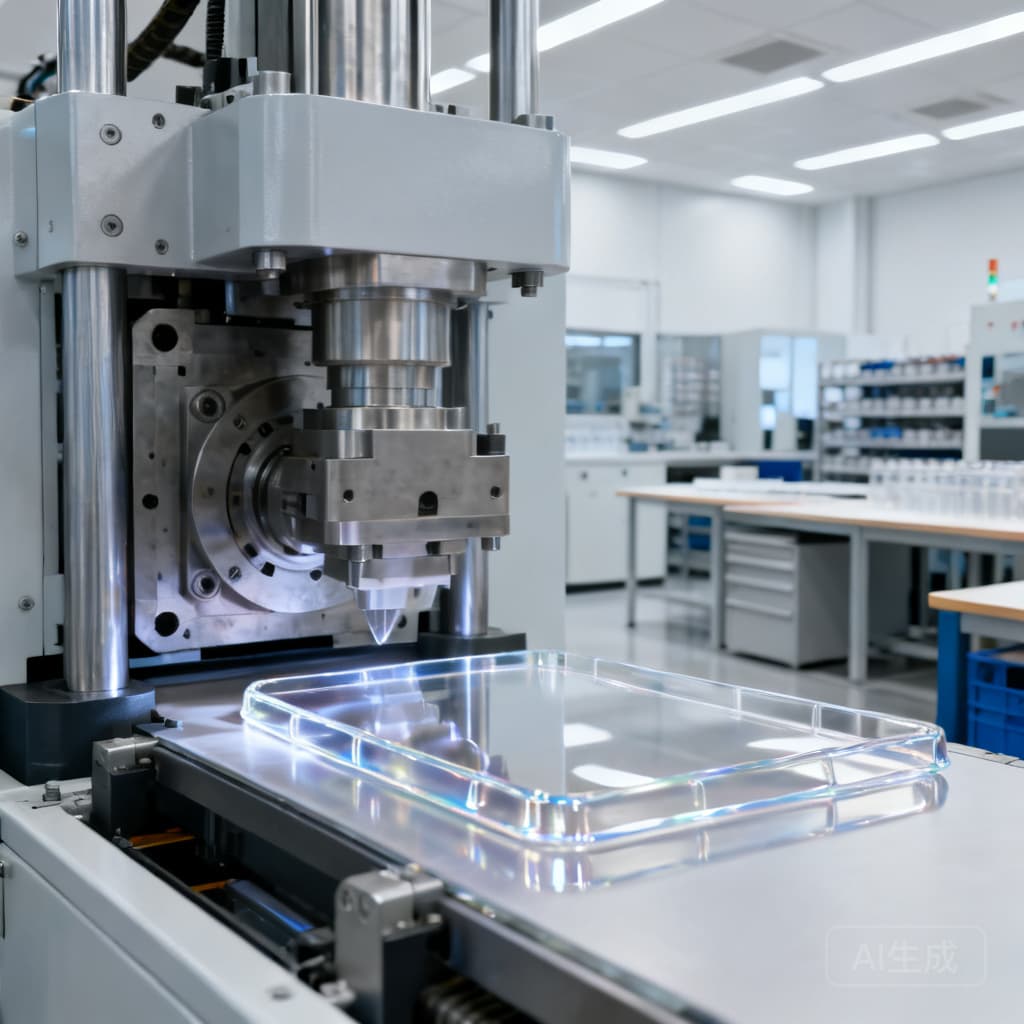
Warp, flash, and cycle-time overrun often compromise transparent display covers. Panda Molding’s ABS/PMMA Transparent Display Cover Molding service tackles these issues with precision injection molding, ISO9001 quality systems, and optimized tooling for high-clarity parts. Get reliable, optically clear covers with tight tolerances and competitive lead times.
", "description": "ABS/PMMA Transparent Display Cover Molding — Custom Injection Molding by Panda Molding
\nTransparent display covers for consumer electronics, automotive panels, and medical interfaces demand flawless optical clarity and dimensional stability. Yet common injection molding defects—warp, flash, flow lines, and silver streaks—frequently derail production. Xometry Pro’s defect guide and Madison Group’s analysis show that improper melt temperature, moisture, and tooling cause most cosmetic rejects. At Panda Molding, we combine deep material science with optical-grade mold polishing and drying protocols to deliver ABS/PMMA Transparent Display Cover Molding that meets the highest clarity and dimensional standards.
\n\nService Capabilities
\n- \n
- Tolerances: Achievable part tolerances of ±0.05 mm for critical optical surfaces, with consistent cavity-to-cavity repeatability. \n
- Material Handling: Closed-loop drying to <0.04% moisture content for PMMA (ZetarMold processing guide) and pre-drying of ABS per Farnell ABS datasheet to prevent splay and bubbles. \n
- Mold Polishing: SPI A-1 diamond finish on core and cavity surfaces, with mirror polishing to Ra ≤0.025 μm for maximum light transmission. \n
- Gate & Runner Design: Optimized edge or fan gates with cold or hot runner systems to minimize shear and flow marks, referencing UPMOLD material datasheets for melt flow indices. \n
- Cycle Time Control: Balanced cooling circuits and conformal cooling where needed, targeting cycle times 15–25% faster than industry norms without sacrificing part quality. \n
Material & Process Comparison
\n| Material | \nKey Properties | \nTypical Failure Boundaries | \nProcess Window | \n
|---|---|---|---|
| ABS | \nGood impact strength, lower clarity, easy flow. CavityMold comparison notes predictable shrinkage. | \nWarp at >0.8% shrinkage; gloss variation if mold temperature <50°C; knit lines in complex geometries. | \nMelt temp 210–250°C, mold temp 50–80°C, moderate injection speed. | \n
| PMMA (Acrylic) | \n92% light transmission, UV stable, brittle. RapidDirect PMMA service highlights optical clarity. | \nSilver streaks if moisture >0.04%; flow lines from insufficient melt temp; cracking from overpacking. | \nMelt temp 220–250°C, mold temp 60–90°C, slow to medium fill speed. | \n
| PC (Polycarbonate) | \nHigh impact, 88–91% transmission, higher cost. Sensitive to stress cracking. | \nBubbles from moisture >0.02%; yellowing if barrel residence time too long; high residual stress. | \nMelt temp 280–320°C, mold temp 80–120°C, high injection pressure. | \n
| ABS/PMMA Blend (custom) | \nBalanced clarity and toughness, improved chemical resistance over pure PMMA. LG Chem MMA brochure shows SMMA alternatives. | \nPhase separation if melt temp too low; reduced transparency at high ABS ratios; shrinkage mismatch. | \nMelt temp 230–260°C, mold temp 60–80°C, medium speed, careful drying. | \n
Industries & Applications
\nConsumer electronics housings and display covers require high clarity and scratch resistance—PMMA’s 92% light transmission and ABS’s toughness make the combination ideal for smart home panels and wearable devices. Automotive interior lens covers benefit from the UV stability of PMMA and the impact resistance of ABS, ensuring long-term transparency under dashboard heat. Medical device bezels and protective windows demand biocompatible, easily sterilizable surfaces; our ABS/PMMA Transparent Display Cover Molding meets these with controlled shrinkage and low extractables. Point-of-sale and kiosk screens rely on the material’s excellent printability and durability against frequent cleaning.
\n\nOur Injection Molding Process
\n- \n
- Material Drying & Preparation: PMMA dried at 80°C for 2–4 hours to <0.04% moisture; ABS dried at 80°C for 2 hours. Closed-loop hopper dryers with dew point monitoring prevent moisture-related optical defects. \n
- Mold Design & Tooling: Steel tooling with SPI A-1 finish, optimized gate location to avoid jetting, and adequate venting (0.02–0.03 mm depth) to eliminate burn marks. Conformal cooling lines reduce cycle time and improve part flatness. \n
- Injection & Packing: Medium injection speeds with profiled velocity to push the melt front uniformly. Pack pressure 50–70% of injection pressure, held until gate freeze to minimize sink marks and shrinkage variation. \n
- Post-Molding & Annealing: Parts are cooled uniformly in the mold, then may undergo annealing at 70–80°C to relieve internal stress and enhance optical stability, especially for PMMA-rich blends. \n
Quality Assurance
\nEvery batch of ABS/PMMA Transparent Display Cover Molding undergoes dimensional inspection using CMM or vision systems, referencing 2D drawings and 3D CAD. Surface quality is checked against VDI 3400/SPI standards; optical clarity is verified with haze and transmission meters. We perform melt flow index verification and moisture analysis on incoming resin. Our ISO9001-certified process includes first-article inspection, in-process SPC on critical dimensions, and final audit per AQL sampling. RoHS compliance is standard, and full material certification is available.
\n\nFrequently Asked Questions
\n- \n
- Q: What materials are compatible with ABS/PMMA Transparent Display Cover Molding? \n
- A: We primarily process ABS, PMMA, and their blends, including custom formulations to balance clarity, impact, and cost. PC and SMMA are also available when higher heat resistance or lower moisture absorption is required. Our engineers recommend the best resin based on your optical, mechanical, and environmental requirements, using datasheets from UPMOLD and LG Chem. \n
- Q: What is the typical lead time? \n
- A: Prototype tooling and first samples can be delivered in 3–4 weeks. Production tooling lead time is 5–7 weeks, with mass production commencing 1–2 weeks after sample approval. Expedited services are available for urgent programs. \n
- Q: What are the MOQ requirements? \n
- A: For prototype and low-volume needs, we accept orders as low as 100 parts. Production MOQ is typically 1,000 units, but we can accommodate smaller runs with shared tooling or flexible scheduling. High-volume production runs of 100,000+ parts benefit from multi-cavity tooling and reduced unit costs. \n
Request a Free Quote
\nUpload your CAD files or 2D drawings for a free, no-obligation DFM review and competitive quote. Our engineering team will analyze part geometry, material selection, and tooling strategy to optimize your ABS/PMMA Transparent Display Cover Molding project. Expect a response within 24 hours with detailed feedback and pricing. Start your quote now.
\n\nReferences & Further Reading
\n- \n
- Transparent & Optical Parts Injection Molding: PMMA, PC and Optical Polymers — Complete Manufacturing Guide \n
- 16 Common Injection Molding Defects: Causes & Solutions | Xometry Pro \n
- 16 Common Injection Molding Defects: Types, Causes, and Solutions | Xometry Asia \n
- Using Data to Pinpoint Cosmetic Defect Causes in Injection Molded Parts \n
- ABS vs PC vs PMMA: Which Material Is Best for Your Next Project? \n
- PMMA (Acrylic) Injection Molding | RapidDirect Manufacturing \n
- PMMA Injection Molding Processing Guide | ZetarMold \n
- Plastic Injection Material Property Datasheet \n
- 2017 PMMA & SMMA Brochure | LG Chem \n
- Technical data sheet ABS | Farnell \n