AGV Robot Chassis Component Molding
Optimize your automated guided vehicle performance with precision AGV Robot Chassis Component Molding from pandamolding.com. Our industrial-grade injection molding delivers high-strength, dimensionally stable chassis parts that withstand demanding logistics environments, ensuring reliable navigation and payload integrity for your fleet.
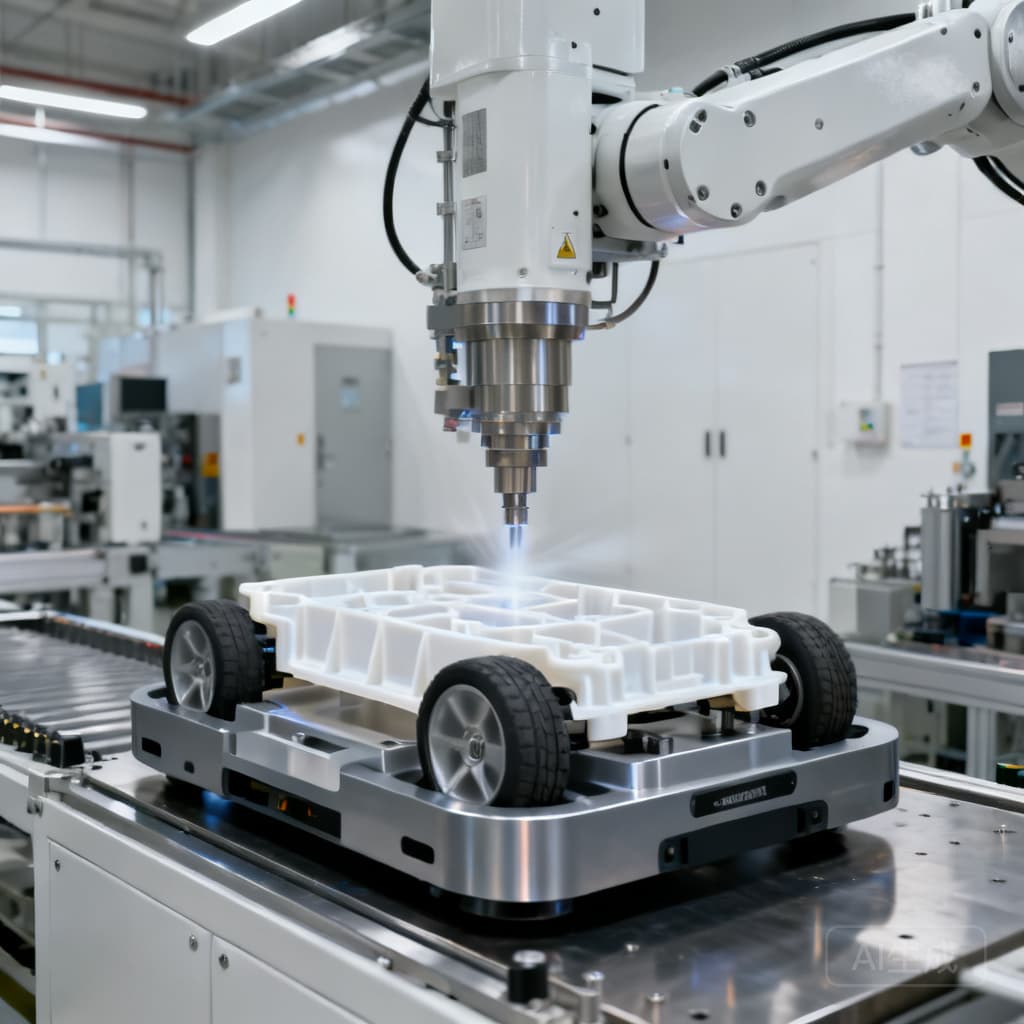
Overview
AGV Robot Chassis Component Molding demands precision to avoid costly defects like warpage, flash, and cycle-time overruns that delay autonomous vehicle deployment. Panda Molding delivers ISO9001-certified injection molding services with tight tolerances, engineered material selection, and robust quality assurance—ensuring your AGV chassis components meet rigorous industrial performance standards from prototype through production.
", "description": "AGV Robot Chassis Component Molding — Custom Injection Molding by Panda Molding
\nAGV Robot Chassis Component Molding is a precision injection molding service engineered for the structural and functional plastic parts that form the backbone of automated guided vehicles—from chassis frames and sensor brackets to wheel housings and battery enclosures. As research on injection molded parts defect detection confirms, common failure modes include dirt contamination, surface injury, material shortage (short shots), and sprue-related defects—all of which compromise AGV structural integrity. Panda Molding addresses these risks head-on with ISO9001-certified processes, delivering components that hold tolerances as tight as ±0.05mm across production runs. When autonomous vehicle recalls like Zoox's 332-unit software-related action underscore how component-level failures cascade into fleet-wide safety issues, our disciplined approach to injection mold tooling, material science, and in-process quality control becomes a critical supply chain advantage for AGV manufacturers and integrators.
\n\nService Capabilities
\n- \n
- Multi-Cavity Tooling with Balanced Runner Systems: We design naturally balanced or rheologically tuned runner layouts that minimize cavity-to-cavity fill variation to under 2%, preventing the short-shot and flash defects commonly seen in industrial production environments where defective parts are heavily underrepresented in training datasets—meaning your production QC must catch what statistical models miss. \n
- Engineered Shrinkage Compensation: For crystalline resins like PA6-GF30 used in structural AGV chassis frames, we apply cavity-specific shrinkage factors (typically 0.8–1.8% depending on fiber orientation) derived from Moldflow analysis, eliminating post-mold warpage that causes assembly misalignment. \n
- Insert Molding for Threaded Fasteners: Brass and stainless steel inserts are placed via automated end-of-arm tooling on our injection molding robots, achieving positional accuracy of ±0.10mm—critical for chassis components that must interface with motor mounts, caster assemblies, and sensor arrays. \n
- Gas-Assist and Structural Foam Options: For large-format AGV chassis panels exceeding 400mm in any dimension, we offer gas-assisted injection molding to reduce sink marks and part weight by 15–25% while maintaining flexural modulus above 6,000 MPa. \n
- In-Line Dimensional Inspection: Every shot is monitored for peak injection pressure, cushion position, and cooling time. Parts are sampled per AQL 1.0 (normal inspection) on a CMM with automated reporting tied to cavity number, enabling rapid root-cause identification when process drift occurs. \n
Material & Process Comparison for AGV Chassis Components
\n| Material / Process | \nTypical AGV Application | \nKey Advantage | \nFailure Boundary | \n
|---|---|---|---|
| PA6-GF30 (30% Glass-Filled Nylon 6) — Injection Molded | \nStructural chassis frames, load-bearing brackets, wheel hubs | \nTensile strength ≥160 MPa; continuous service temperature to 120°C | \nWarpage exceeds 0.3% of span when wall thickness drops below 2.5mm or fiber orientation becomes anisotropic across the cavity | \n
| PC/ABS Blend — Injection Molded | \nHousings, covers, operator interface panels, sensor enclosures | \nExcellent impact resistance (Izod >500 J/m); UL94 V-0 grades available | \nWeld line strength falls below 70% of base material tensile when melt temperature at the knit line drops below 260°C—common in multi-gate layouts | \n
| PBT-GF20 (20% Glass-Filled Polybutylene Terephthalate) — Injection Molded | \nSensor brackets, connector housings, electrical isolation components | \nHigh dielectric strength; low moisture absorption (<0.1% at 23°C/50% RH) | \nShrinkage variation exceeding 1.5% across cavities when hold pressure is insufficient or gate freeze-off occurs prematurely | \n
| TPE Overmold on PP Structural Core — Two-Shot Injection Molding | \nSealing gaskets, vibration-damping mounts, wheel treads | \nChemical bond eliminates adhesive; Shore A 40–80 hardness range | \nDelamination at the bond line when substrate surface temperature drops below 80°C before overmold injection—peel strength <5 N/mm indicates bond failure | \n
Table notes: Material selection must align with the AGV's duty cycle, payload class, and operating environment. As noted in OEM vs ODM manufacturing comparisons, the factory's tooling capability directly determines whether your approved vendor list (AVL) materials can be processed within specification. For injection molding robot integration, automation costs typically range from $50,000–$150,000 per unit, making it essential to partner with a molder that already has this infrastructure in place. Choosing the right AGV involves more than comparing specifications—the same principle applies to choosing the right injection molding partner for chassis components. As industry comparisons between AGV and RGV systems show, an AGV provides better value in busy multi-machine shops—and the plastic components enabling that flexibility must be molded to exacting standards.
\n\nIndustries & Applications
\nAGV Robot Chassis Component Molding serves warehouse logistics providers deploying fleets of 150kg–6,000kg payload automated guided vehicles—a range consistent with established AGV manufacturer catalogs. In automotive assembly plants, our glass-filled nylon structural brackets withstand continuous vibration and occasional impact from tooling fixtures. For semiconductor cleanroom AGVs, we mold static-dissipative PC/ABS blends with surface resistivity controlled between 10⁶–10⁹ Ω/sq. In e-commerce fulfillment centers, high-cycle AGV wheel hubs molded from toughened PA6 withstand 24/7 operation on polished concrete floors. Each application demands specific material properties—creep resistance for constant loads, fatigue endurance for cyclic loading, and dimensional stability across temperature swings from unheated warehouses to sun-exposed loading docks.
\n\nOur Injection Molding Process
\n- \n
- DFM Review & Mold Flow Simulation: Every AGV chassis component CAD file undergoes design-for-manufacturability analysis. We simulate melt front propagation, identify potential gas traps, predict knit line locations, and optimize gate placement—all before cutting steel. For structural parts, we validate that predicted shrinkage (typically 0.5–1.5% for amorphous resins, 1.0–2.5% for semi-crystalline) is compensated in the cavity geometry. \n
- Tooling Fabrication with AGV-Specific Considerations: Mold bases are built from P20 or hardened H13 tool steel (50–54 HRC) depending on production volume. Cavities receive diamond-polished surfaces (SPI A-2 or better) for cosmetic chassis panels. Slides and lifters accommodate undercuts for snap-fit features common in AGV housing assemblies. Conformal cooling channels are added when cycle time reduction beyond 15% is required. \n
- Process Window Development: We establish a robust process window by mapping melt temperature (typically 240–290°C for PA6-GF30, 250–280°C for PC/ABS), injection velocity, hold pressure profile, and cooling time against part weight and dimensional output. The process window is validated across at least three lots of material to account for resin batch variation. \n
- Production with Real-Time SPC: Cavity pressure sensors and in-mold temperature probes feed data to our SPC system. If peak cavity pressure deviates beyond ±5% of the established mean, the system alerts operators before non-conforming parts are produced. Cycle times for AGV chassis components typically range from 25–65 seconds depending on wall thickness (2.5–6.0mm) and material. \n
Quality Assurance
\nPanda Molding operates under ISO9001:2015 certified quality management. Every AGV Robot Chassis Component Molding project includes a First Article Inspection Report (FAIR) per AS9102 guidelines, documenting dimensional verification of all critical-to-function features. Material certifications are provided for every resin lot, including melt flow index, filler content verification (TGA for glass-filled grades), and moisture content analysis (Karl Fischer titration, target <0.15% for hygroscopic resins like PA6). Surface finish is inspected to SPI/VDI standards using visual comparators and profilometry where specified. For functional validation, we perform assembly fit-checks with mating AGV components (motor mounts, bearing seats, connector cutouts) using customer-supplied or 3D-printed reference fixtures. RoHS compliance is maintained across all material selections, and we provide full disclosure of any substances of concern per REACH when requested. The AGV and AMR System Design Manual emphasizes that component reliability directly impacts overall system availability—a principle that governs our quality approach.
\n\nFrequently Asked Questions
\n- \n
- Q: What materials are compatible with AGV Robot Chassis Component Molding? \n
- A: We process engineering thermoplastics including PA6, PA66, PA12 (with 15–50% glass fiber loading), PC/ABS blends, PBT, POM, and PPS for high-temperature applications. Material selection is guided by the AGV's payload class—light-duty AGVs under 500kg may use unreinforced PC/ABS for non-structural housings, while heavy-duty chassis frames exceeding 2,000kg payload require glass-filled nylon with tensile modulus above 8,000 MPa. We also mold specialty grades including UL94 V-0 flame-retardant compounds, static-dissipative materials for electronics protection, and hydrolysis-stabilized resins for humid operating environments. If your design specifies a material from your approved vendor list, we can qualify it through our ISO9001 supplier management process. \n
- Q: What is the typical lead time for AGV chassis component tooling and production? \n
- A: Prototype tooling (single-cavity, aluminum or P20 steel) typically requires 3–5 weeks from CAD approval to T1 sample delivery. Production tooling (multi-cavity, hardened steel) ranges from 6–10 weeks depending on complexity—slides, lifters, and conformal cooling add approximately 1–2 weeks each. First production shipments typically begin 2–3 weeks after tool approval. Expedited programs can compress prototype tooling to 2 weeks when capacity allows. We recommend budgeting 12–16 weeks total from design freeze to steady-state production for a typical AGV chassis component program. \n
- Q: What are the MOQ requirements for AGV Robot Chassis Component Molding? \n
- A: For prototype and low-volume production (50–500 units), we offer single-cavity tooling with no minimum order quantity beyond covering setup and material costs. For production tooling amortized across higher volumes, typical MOQs range from 1,000–5,000 units annually depending on part size and complexity. Multi-cavity tools (4–8 cavities) become cost-justified at volumes exceeding 10,000 units per year. We work with AGV startups needing initial batches of 100–200 units for pilot deployments as well as established manufacturers running 50,000+ units annually. Our tooling is designed for a minimum service life of 500,000 cycles for production molds, ensuring your investment scales with your AGV fleet growth. \n
Request a Free Quote
\nUpload your CAD files (STEP, IGES, or native SolidWorks/Inventor formats) along with your target annual volume and any material specifications for a free DFM review and quotation. Our engineering team provides feedback within 48 hours—covering gate location recommendations, draft angle requirements, wall thickness optimization, and estimated tooling and piece-part costs. Whether you are prototyping a next-generation AGV design or scaling production of an existing platform, Panda Molding delivers the injection molding expertise your chassis components demand. Contact us at pandamolding.com to start your project.
\n\n