EV Battery Enclosure Plastic Molding
Panda Molding delivers precision EV battery enclosure plastic molding for the automotive industry. Our advanced injection molding produces lightweight, flame-retardant housings with superior impact resistance and tight tolerances, ensuring battery safety and longevity in demanding electric vehicle applications.
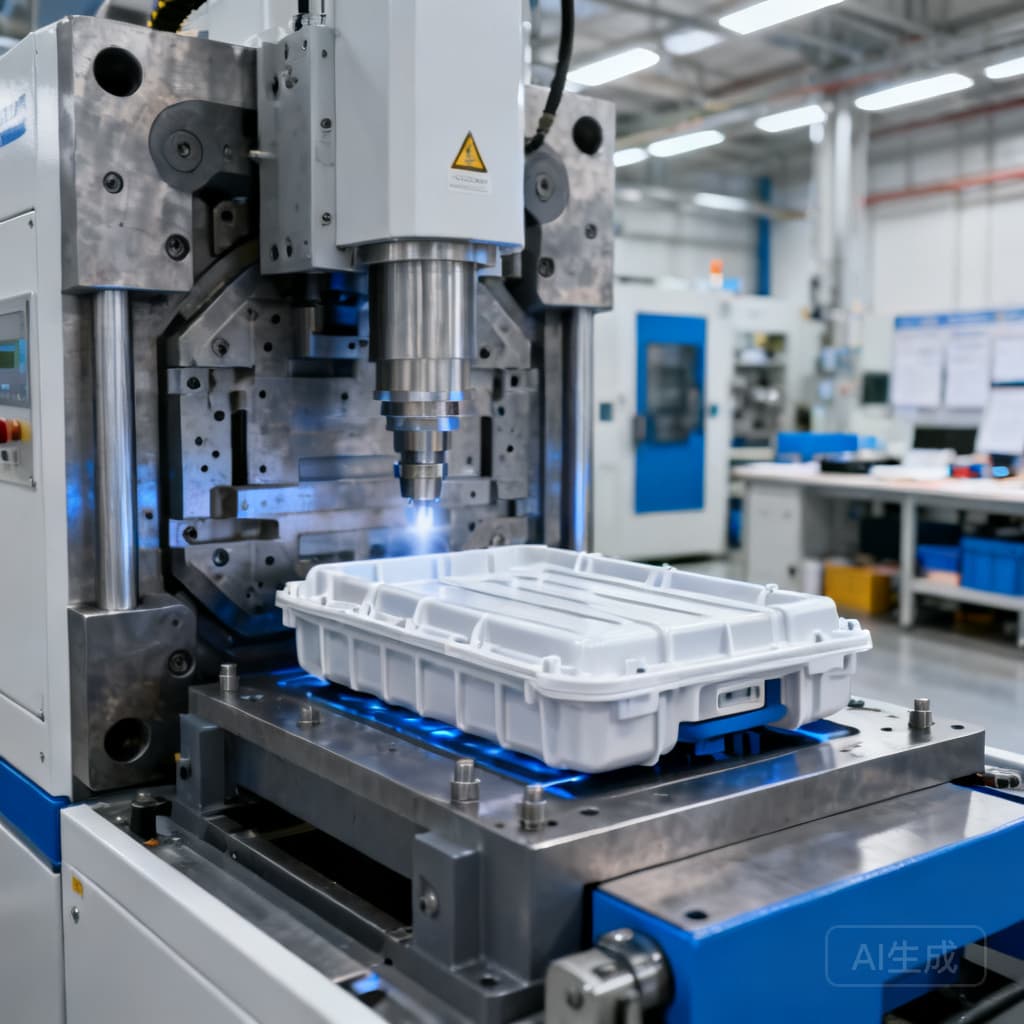
Overview
EV battery enclosures face intense thermal, mechanical, and safety demands. Warpage, flash, and extended cycle times plague conventional molding. Panda Molding’s EV Battery Enclosure Plastic Molding service delivers precision injection molded housings with flame-retardant thermoplastics, tight tolerances, and ISO9001-certified quality—eliminating costly recalls and production delays.
", "description": "EV Battery Enclosure Plastic Molding — Custom Injection Molding by Panda Molding
\nRecent recalls expose the cost of enclosure failures: Mercedes’ EQB battery management issues (autoevolution), Tesla’s faulty battery contactor housing (InsideEVs), VW’s 94,000-vehicle recall for out-of-spec modules (eletric-vehicles.com), and Nissan Leaf fire risk from battery pack defects (Autoblog). Warpage, flash, and poor venting in plastic enclosures can compromise sealing, structural integrity, and thermal runaway containment. Panda Molding’s EV Battery Enclosure Plastic Molding service tackles these risks head-on with advanced tooling, process control, and ISO9001-certified manufacturing. We engineer large-format, flame-retardant enclosures that meet UL 94 V-0 and tight dimensional tolerances, delivering repeatable quality from prototype to high-volume production.
\n\nService Capabilities
\n- \n
- Press Tonnage up to 3,000 Tons: Accommodates large battery trays and enclosures, as required by Tesla, BYD, and VW ID. series (Daoben). \n
- Tolerances of ±0.1 mm on Sealing Surfaces: Critical for maintaining IP67/IP69K ingress protection and preventing moisture intrusion. \n
- UL 94 V-0 Flame-Retardant Materials: PA6-GF, PP-GF, and PC/ABS formulations with optimized flow for thin-wall sections, reducing weight and cycle time. \n
- Advanced Venting Design: Vent depths of 0.02–0.05 mm at weld lines and flow-front endpoints prevent burn marks and short shots, following best practices (Topworks). \n
- Conformal Cooling & Optimized Gate/Runner Systems: Minimize warpage and cycle time overrun by balancing filling pressure and shrinkage across the cavity. \n
Industries & Applications
\nOur EV Battery Enclosure Plastic Molding serves the automotive electrification sector where safety, weight reduction, and cost efficiency are paramount. Injection-molded thermoplastics offer inherent corrosion resistance, UV stability, and lower CO2 footprint compared to steel or aluminum (AMS). Key applications include full battery pack housings, module frames, high-voltage connector housings, and charging port assemblies. The materials’ low viscosity enables large-scale production on existing injection moulding equipment without massive capital investment (eMobility Engineering), while their chemical resistance reduces lifecycle maintenance costs (E-Business International).
\n\nOur Injection Molding Process
\n- \n
- Material Conditioning: Engineering resins like PA66-GF are dried to <0.02% moisture to prevent hydrolysis and maintain mechanical properties. Melt temperature is precisely controlled (e.g., PA6-GF at 260–290°C) for optimal flow. \n
- Mold Flow & Tooling Design: Gate location and runner balancing are optimized via simulation to minimize knit lines and ensure uniform filling. Vent land width is set to ~1.5 mm before relief, with multiple vents opposite the gate (Topworks). \n
- Injection & Packing: Injection pressure up to 150 MPa packs the cavity, followed by a controlled holding phase to compensate for shrinkage. Cycle time is benchmarked against industry standards to avoid overrun. \n
- Post-Molding Inspection: Parts undergo dimensional verification on CMM, visual inspection for flash and burn marks, and functional leak testing where required. Material certificates per UL and RoHS are provided. \n
Quality Assurance
\nEvery EV Battery Enclosure Plastic Molding project follows ISO9001:2015 procedures. Dimensional reports are generated from CMM data, and surface finish is checked against SPI standards. We validate flame retardancy through UL 94 testing and can coordinate third-party material certification through UL’s automotive testing services (UL). RoHS compliance is standard. For enclosures, we perform pressure decay or helium leak tests to confirm sealing integrity, addressing the failure modes highlighted in recent recalls.
\n\nFrequently Asked Questions
\n- \n
- Q: What materials are compatible with EV Battery Enclosure Plastic Molding? \n
- A: We process flame-retardant PA6-GF, PA66-GF, PP-GF, and PC/ABS blends that meet UL 94 V-0. Material selection is guided by thermal requirements (continuous use up to 150°C), impact resistance, and chemical compatibility with battery electrolytes. We can also source specialty grades from SABIC and other approved suppliers. \n
- Q: What is the typical lead time? \n
- A: Prototype tooling and initial samples can be delivered in 4–6 weeks. Production tooling typically requires 8–10 weeks, with first-article inspection reports included. After tool approval, production lead times are 6–8 weeks, depending on order volume and material availability. \n
- Q: What are the MOQ requirements? \n
- A: For prototyping and low-volume validation, we accept orders as low as 50 pieces. Production MOQ is typically 1,000 units per run, though this can be adjusted based on part size, material, and tooling investment. We support scaling from pilot runs to high-volume production seamlessly. \n
Request a Free Quote
\nUpload your CAD files or 2D drawings for a complimentary DFM review and competitive quote. Our engineering team will analyze gate placement, venting, and material flow to optimize your EV Battery Enclosure Plastic Molding design for manufacturability. Expect a detailed proposal within 48 hours, backed by ISO9001-certified quality and transparent lead times.
\n\nReferences & Further Reading
\n- \n
- Mercedes Recalls EQB Crossovers for Batteries That May Fail Internally - autoevolution \n
- Recalls - Electric Vehicle News and Trends | InsideEVs \n
- Volkswagen Group Recalls Nearly 100,000 EVs Over Battery Module Defect | EV \n
- Nissan Recalls 2026 Leaf EV That Could Catch Fire While Parked - Autoblog \n
- Lightweight EV Battery Enclosures: Aluminium, Steel, Composites \n
- The evolution of EV battery enclosures: balancing optimisation, safety and cost-effectiveness | Article | Automotive Manufacturing Solutions \n
- EV Manufacturing Trends: Injection Molding Applications for Battery Enclosures and Charging Ports | E-Business International \n
- Top 10 Injection Molding Automotive Parts Guide | Daoben \n
- EV Battery Enclosure Tooling -Topworks Plastic Molding \n
- UL.com/automotivematerials Automotive Testing and Engineering Services \n
- Compression Molded Composite EV Battery Enclosures - SUASE \n
- Automotive Injection Molding: Materials & Sourcing Guide \n