Food-Grade PP Container Injection Molding
Pandamolding.com specializes in high-precision food-grade PP container injection molding for the packaging industry. Our advanced processes ensure durable, BPA-free, and FDA-compliant containers with tight tolerances and rapid cycle times. From design to mass production, we deliver cost-effective, safe, and scalable solutions for your food packaging needs.
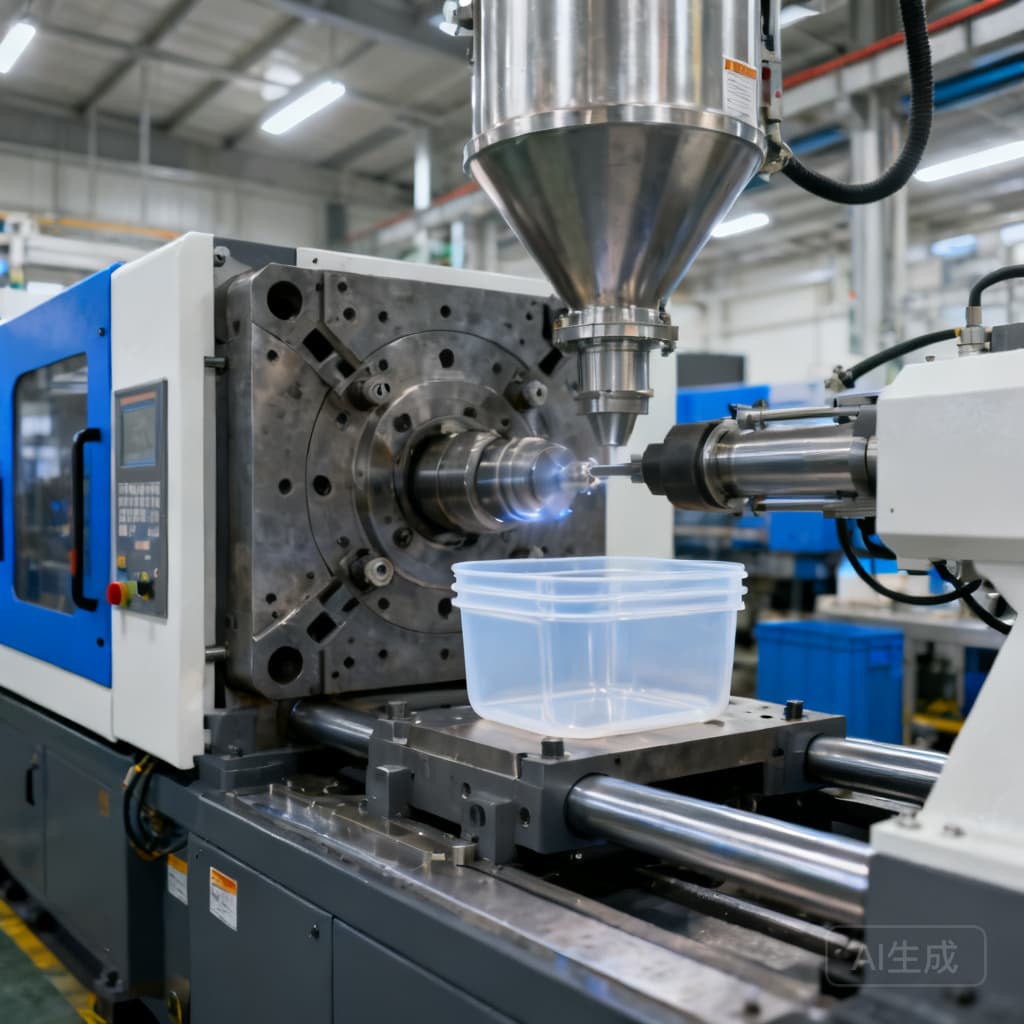
Overview
Food-Grade PP Container Injection Molding demands flawless production—warp, flash, or cycle‑time overruns can halt packaging lines. Panda Molding’s ISO9001‑certified service eliminates these risks with precision tooling, optimized melt control, and validated food‑safe processes, delivering consistent, high‑volume containers that meet the strictest migration and dimensional standards.
", "description": "Food-Grade PP Container Injection Molding — Custom Injection Molding by Panda Molding
When a thin‑wall polypropylene container warps out of tolerance or a gate vestige traps food residue, the entire supply chain suffers. Food‑grade PP container injection molding is unforgiving: even a 0.2 mm deviation can cause stackability failures or sealing defects. Panda Molding’s ISO9001‑certified service tackles these pain points head‑on. We engineer every mold to balance melt flow, cooling uniformity, and shrinkage compensation—delivering containers that meet EU 10/2011 and FDA 21 CFR migration limits without sacrificing cycle time. From 100‑ml sauce cups to 5‑litre pails, our approach gives packaging buyers the dimensional stability and hygiene assurance their lines demand.
Service Capabilities
- Multi‑cavity tooling up to 48 cavities: Hot‑runner or cold‑runner systems with valve gates for clean, consistent gate vestiges that comply with food‑contact surface requirements.
- Melt temperature control ±2 °C: Process window 200–250 °C for food‑grade PP homopolymer and random copolymer, preventing thermal degradation that causes off‑taste or brittleness.
- Shrinkage‑compensated mold design: PP shrinkage of 1.0–2.5 % is pre‑compensated using Moldflow simulation; critical dimensions held to ±0.05 mm on sealing surfaces.
- Cycle time optimization: Conformal cooling channels and optimized wall thickness (0.4–2.0 mm) reduce cycle time to 6–12 seconds for thin‑wall containers, preventing sink marks and flash.
- In‑mold labelling (IML) capability: Fully integrated IML automation places labels inside the cavity before injection, creating a scratch‑proof, food‑safe decoration that withstands microwave reheating.
Industries & Applications
Food‑grade PP container injection molding is the backbone of modern packaging. Dairy manufacturers rely on our tubs and lids for yogurt and butter, where a uniform rim thickness prevents leakage and ensures a positive snap‑fit. Ready‑meal producers need containers that survive freezer‑to‑microwave thermal shock without cracking—we select PP grades with high ethylene content for impact resistance at −20 °C. Deli and takeaway containers demand clarity and stackability; we use clarified random copolymer PP and design draft angles of 1–2° to avoid scuffing. In each case, the injection mold must deliver repeatable cavity pressure to avoid flash while keeping cycle time under 10 seconds—a balance Panda Molding achieves through validated process parameters and real‑time monitoring.
Material & Process Comparison
| Material Grade | Melt Flow Index (g/10 min) | Typical Shrinkage (%) | Failure Boundary | Best Suited Application |
|---|---|---|---|---|
| PP Homopolymer (e.g., Sabic 500P) | 2–5 | 1.5–2.0 | Warpage if mold temperature >80 °C; brittle below 0 °C | Thick‑walled pails, caps, closures |
| PP Random Copolymer (e.g., Borpact BC918CF) | 10–30 | 1.2–1.8 | Flash if injection speed too high; hazing if cooling rate uneven | Thin‑wall dairy cups, deli containers |
| Clarified PP (e.g., Millad NX8000 grade) | 15–40 | 1.0–1.5 | Loss of clarity if melt temperature <230 °C; sink marks opposite ribs | Transparent takeaway boxes, microwaveable trays |
| PP + 20 % Talc Filled | 5–15 | 0.8–1.2 | Brittle failure at low temperature; increased tool wear | Rigid lids, structural bases requiring stiffness |
Our Injection Molding Process
- DFM & Mold Flow Analysis: We simulate melt front progression, gate freeze time, and warpage tendency. Gate location is chosen to eliminate weld lines on food‑contact surfaces, and the runner system is balanced for multi‑cavity tools.
- Material Preparation: Food‑grade PP resin is dried to <0.05 % moisture (if required) and fed via closed‑loop gravimetric blenders. We use only resins with full FDA and EU compliance documentation.
- Injection & Packing: Melt is injected at 80–140 MPa pressure with profiled speed control to prevent jetting. A packing phase of 50–70 % of injection pressure compensates for PP’s high volumetric shrinkage, eliminating sink marks.
- Cooling & Ejection: Mold temperature is maintained at 20–60 °C with turbulent‑flow cooling circuits. Ejection uses large‑area stripper plates to avoid part distortion, and robots handle parts to prevent contamination.
Quality Assurance
Every production batch undergoes dimensional inspection using CMM and vision systems, with CpK ≥1.33 for critical sealing dimensions. We perform overall migration testing per EU 10/2011 (simulants A, B, D2) and specific migration limit checks for additives. Drop impact tests at 0–5 °C verify container integrity for cold‑chain logistics. Our ISO9001‑certified quality system tracks cavity‑specific data, and we maintain full lot traceability from resin certificate to finished pallet. RoHS compliance is inherent for unfilled PP; we confirm absence of heavy metals via XRF screening when requested.
Frequently Asked Questions
- Q: What materials are compatible with Food-Grade PP Container Injection Molding?
- A: We process a wide range of food‑compliant PP grades—homopolymer, random copolymer, and clarified grades with MFI from 2 to 40 g/10 min. All materials are sourced from approved suppliers (e.g., Borealis, LyondellBasell, Sabic) and come with full FDA 21 CFR and EU 10/2011 compliance statements. Custom color masterbatches are also available, provided they meet migration limits.
- Q: What is the typical lead time?
- A: Prototype tooling for a single‑cavity test mold takes 4–6 weeks, with first‑off samples delivered within 7 days of tool completion. Production‑grade multi‑cavity tools (up to 48 cavities) require 8–12 weeks. After tool approval, production parts ship in 2–3 weeks, depending on volume and secondary operations like IML or pad printing.
- Q: What are the MOQ requirements?
- A: For prototype and pilot runs, we accept orders as low as 100–500 pieces to validate design and process parameters. Full production typically starts at 10,000 units per cavity per order, but we work with startups and can scale gradually. Our flexible production scheduling allows for smaller batches during market testing phases.
Request a Free Quote
Upload your 3D CAD or 2D drawing for a free DFM review and quotation. Our engineers will assess wall thickness, draft angles, and gate placement to optimize your food‑grade PP container design for injection molding. You’ll receive a detailed feedback report and competitive pricing within 48 hours. Start your project with Panda Molding today.
" }