PEEK High-Temperature Engineering Resin
Discover the exceptional performance of PEEK high-temperature engineering resin for demanding injection molding applications. With continuous service up to 260°C, outstanding chemical resistance, and superior mechanical strength, PEEK replaces metals in aerospace, medical, and oil & gas components, delivering lightweight, durable solutions where standard thermoplastics fail.
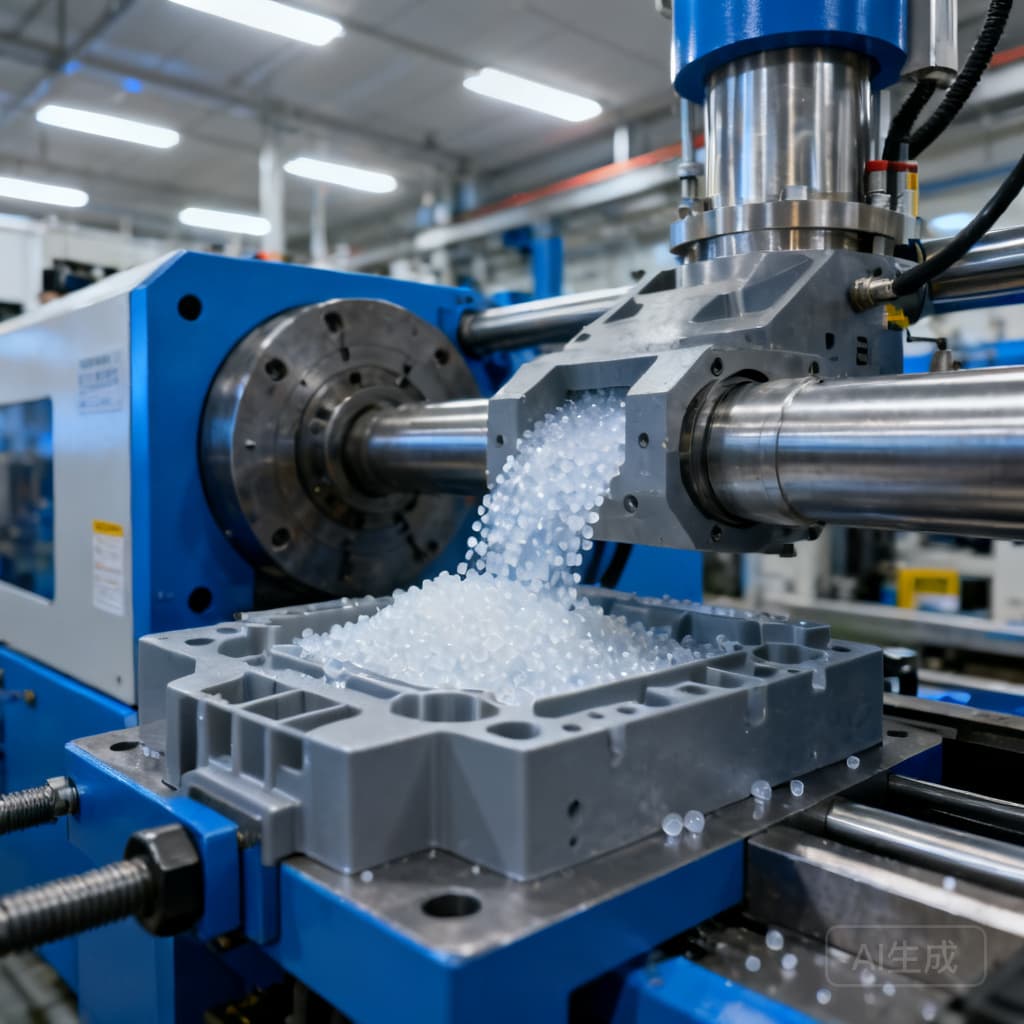
Overview
Struggling with PEEK High-Temperature Engineering Resin injection molding defects like warp, flash, or short shots? Panda Molding's ISO9001 certified process eliminates these failures through precise melt-temperature control, optimized tooling, and real-time cavity-pressure monitoring. Get dimensionally stable, high-performance parts for aerospace, medical, and oil & gas applications—without the cycle-time overruns that erode your margins.
", "description": "PEEK High-Temperature Engineering Resin — Custom Injection Molding by Panda Molding
\nPEEK (polyetheretherketone) is the go-to high-temperature engineering resin for components that must survive continuous service at 250°C, resist aggressive chemicals, and maintain dielectric strength under load. Yet processing it pushes injection molding machines and tooling to their absolute limits. Tool degradation from processing temperatures exceeding 400°C is the number one hidden cost, while short shots and incomplete fill plague complex geometries. Panda Molding approaches PEEK High-Temperature Engineering Resin as a system challenge—not just a material—by pairing hardened H-13/S-7 tool steel with calibrated melt delivery and documented process windows. We deliver fully dense, flash-free parts that meet AS9100 expectations, backed by ISO9001 traceability and in-house metrology.
\n\nMaterial Specifications & Properties
\n- \n
- Continuous Service Temperature: 250°C (unfilled); 260°C+ for carbon-fiber reinforced grades, per Victrex PEEK property data. \n
- Melt Temperature Range: 360–400°C for unfilled PEEK; up to 420°C for filled compounds. Screw tip clearance must be 3 mm for virgin PEEK, 2 mm for compounds to maintain a full, sustained injection pressure. \n
- Mold Shrinkage: 1.2–1.8% for unfilled grades; 0.5–1.2% for glass/carbon filled. Shrinkage anisotropy demands uniform cooling circuits and gate placement to prevent warpage. \n
- Tensile Strength: 90–100 MPa at 23°C (unfilled), with modulus >3.6 GPa. Data sheet values represent averages from injection molded specimens. \n
- Dielectric Strength: 19 kV/mm (1.6 mm thickness), making it ideal for aerospace connector bodies and insulating sleeving where hot-zone circuit protection is critical. \n
Process & Material Comparison
\nSelecting the right high-temperature resin involves balancing thermal capability, processing difficulty, and cost. The table below contrasts PEEK with three common alternatives, highlighting failure boundaries that inform tooling strategy and part design.
\n| Material | Max Service Temp (°C) | Injection Molding Difficulty | Typical Failure Modes | Low-Volume Part Cost (USD) |
|---|---|---|---|---|
| PEEK | 250–260 | Very High: requires 380–420°C melt, oil-heated molds at 180–200°C | Short shots, gate blush, thermal degradation if residence time >5 min | $50–150 (under 500 units) |
| PEI (Ultem) | 170–200 | High: melt 340–400°C, mold 120–150°C | Brittle fracture at thin walls, stress cracking | $30–80 |
| PPS | 200–220 | Moderate: melt 290–330°C, mold 80–150°C | Flash if venting inadequate, outgassing | $20–60 |
| LCP | 240–280 | Moderate: melt 280–340°C, mold 30–150°C | Anisotropic shrinkage, weld-line weakness | $25–70 |
Cost ranges based on PTSmake analysis and nylonplastic.com material comparison. For prototyping, CNC machining from extruded PEEK stock is often preferred below 500 parts per year, though material cost per kg is higher.
\n\nTypical Applications
\nAerospace: Injection molded PEEK parts such as connector backshells, insulating sleeving, and hydraulic system seals exploit the material’s excellent dielectric strength and flame retardance (UL94 V-0). Panda Molding’s process eliminates internal voids that could cause partial discharge in high-altitude environments.
\nMedical: PEEK’s radiolucency and biocompatibility make it the standard for surgical instrument handles, spinal cages, and dental abutments. Our ISO9001 validated process ensures traceable lot control and consistent crystallinity for mechanical performance.
\nOil & Gas: Downhole connectors and seal rings molded in carbon-fiber-filled PEEK withstand 200°C+ in sour gas environments. We calibrate injection pressure and mold temperature to eliminate internal defects that lead to premature failure under high pressure.
Processing Guidelines
\n- \n
- Material Drying: PEEK resin must be dried to <0.02% moisture content (typically 3–4 hours at 150°C in a desiccant dryer). Inadequate drying causes splay and hydrolytic degradation during injection mold filling. \n
- Melt Temperature Control: Set barrel zones to 360–400°C for unfilled grades. Residence time must not exceed 5 minutes to avoid thermal degradation. Common defects like black specks or brittleness often trace back to excessive residence time. \n
- Mold Temperature: Maintain cavity surface temperature at 180–200°C using oil heating. This is critical for achieving proper crystallinity and minimizing shrinkage variation. Cold molds cause amorphous skin layers and warpage. \n
- Injection Speed & Pressure: Use fast injection speeds (200–300 mm/s) to prevent premature freezing in thin walls. Hold pressure at 70–100 MPa until gate freeze-off. Screw ring clearance must allow unrestricted forward flow to transfer full pressure into the cavity. \n
Quality Assurance
\nEvery PEEK High-Temperature Engineering Resin production run at Panda Molding undergoes first-article dimensional inspection on a CMM, with critical dimensions held to ±0.05 mm. We perform melt-flow-index verification per ASTM D1238 on retained samples to confirm no degradation occurred during molding. Surface finish is controlled to SPI-A2 or better for sealing surfaces. Our ISO9001:2015 certified QMS mandates full lot traceability from raw resin certificate to final part, and all PEEK grades we process are RoHS compliant. For aerospace programs, we offer PPAP Level 3 documentation and coordinate with your quality team on source inspection.
\n\nFrequently Asked Questions
\n- \n
- Q: What materials are compatible with PEEK High-Temperature Engineering Resin? \n
- A: Panda Molding processes unfilled PEEK, 30% glass-fiber reinforced, 30% carbon-fiber reinforced, and bearing-grade (PTFE/graphite) compounds. We can also mold PEEK blends with PEI or PPS for specific cost-performance targets. All grades require dedicated screw and barrel assemblies to prevent cross-contamination with lower-temperature polymers. \n
- Q: What is the typical lead time? \n
- A: Prototype tooling (aluminum or P-20 steel) can deliver first articles in 2–3 weeks. Production steel tooling (H-13) typically requires 5–7 weeks, with first shots available for approval at week 5. High-volume production runs ship 10–15 business days after tool qualification. \n
- Q: What are the MOQ requirements? \n
- A: For prototyping and bridge production, we accept orders as low as 10 parts. For full production, the economic minimum is typically 500 parts due to the cost of purging and stabilizing the process. We also offer CNC machining from extruded PEEK stock for 1–100 piece requirements, which is often preferred for initial proof-of-concept builds. \n
Request a Free Quote
\nReady to eliminate PEEK molding defects and reduce cycle-time overruns? Upload your 3D CAD and 2D drawings for a complimentary DFM review. Our senior tooling engineers will assess gate location, venting, and cooling layout specific to your PEEK High-Temperature Engineering Resin part. Expect a detailed quote with lead times within 24 hours—no obligation, just straight technical feedback.
" }